Dry Sorbent Injection and Corrosion: Hygroscopic Deposits in Baghouses and Ducts
 Edita RojasovaLast Updated: Nov 18, 2026
Dry Sorbent Injection Corrosion: Key Points
- Dry sorbent injection (DSI) can raise corrosion risk in baghouses and ducts: the reaction products it creates with acid gases include salts that absorb moisture, and some, notably calcium chloride, are deliquescent.
- Wet deposits form where steel is cool or the unit is shut down, so corrosion concentrates in hoppers, under caked deposits, at doors and on the clean side; dry operation does not prove shutdown exposure is benign.
- Sorbent particles also abrade injection zones, duct bends and hopper outlets.
- Fix causes first: hopper heating and insulation, air in-leakage, hopper evacuation before shutdown and deposit sampling.
- Then coat steel that will still see wet deposits: FlueGard®-225SQC, listed for baghouses and ducts to 225 °C (437 °F), resists HCl, SO2 and SO3 and is immersion-rated.
- No DSI-specific Polylloy case study is published, so deposit analysis from the unit itself guides grade selection.
Dry sorbent injection can cause baghouse corrosion, not because the sorbent is acidic, but because its reactions with acid gases leave moisture-absorbing salts, some deliquescent. On cool hoppers, doors and the clean side, and at every shutdown, those deposits form a corrosive film, so plants fix cold spots first and coat steel that still sees wet deposits.
What Dry Sorbent Injection Does to Baghouse and Duct Steel
Dry sorbent injection corrosion is acid and chloride attack on baghouse and duct steel that follows the injection of a dry alkaline sorbent, when moisture-absorbing reaction products deposit on cool or idle steel and form a corrosive liquid film beneath them.
Dry Sorbent Injection Defined
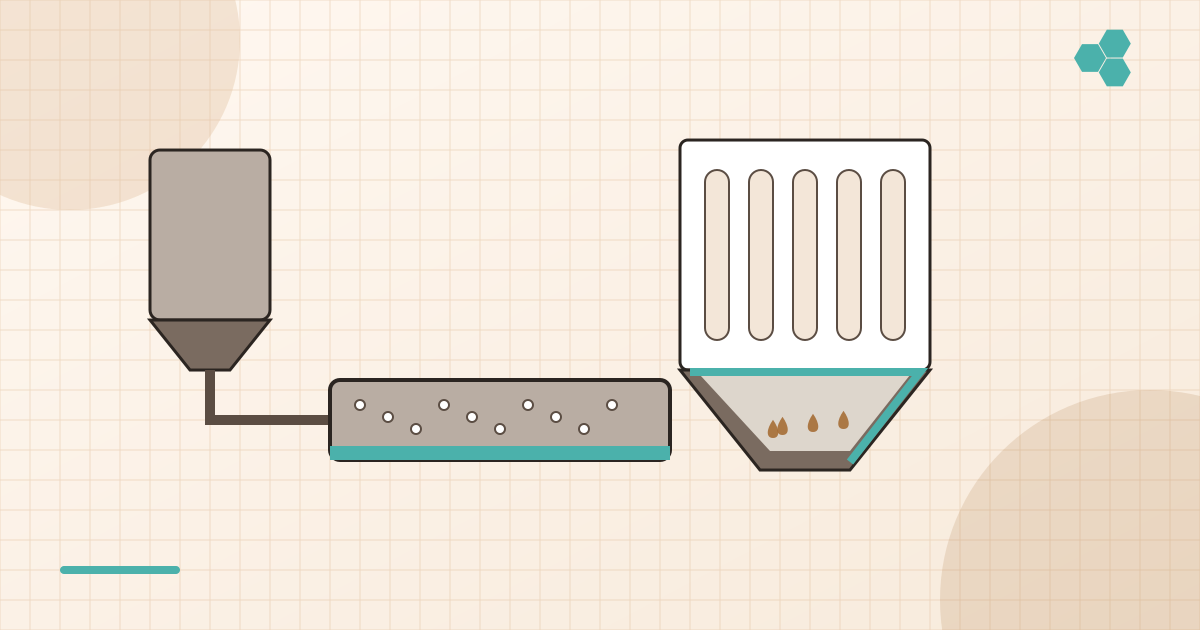
DSI is the injection of a dry alkaline powder, commonly hydrated lime, sodium bicarbonate or trona, into the flue gas ahead of a baghouse. The powder reacts with acid gases such as hydrogen chloride (HCl), sulfur dioxide (SO2) and sulfur trioxide (SO3) and is collected with the dust.
DSI is one of several emissions measures behind a wider post-upgrade corrosion problem. The protection routes after an upgrade are compared in corrosion protection options after an emissions control upgrade.
The Short Answer
The sorbent itself is alkaline; the corrosion risk comes from what it leaves behind on steel that is cool or idle. Think of a salt shaker on a humid day: the salt pours freely while it is dry, then clumps and turns damp once moist air reaches it.
Deliquescent Reaction Products: Why Sorbent Dust Turns Wet
Deliquescent reaction products are why dry sorbent dust can turn wet on steel.
Hygroscopic and Deliquescent Salts
A hygroscopic salt absorbs moisture from the gas. A deliquescent salt absorbs enough moisture to dissolve into a liquid brine.
Calcium-based sorbents reacting with HCl form calcium chloride, which is deliquescent, and the brine can form on cooler steel even when the bulk gas is above its water dew point. The same mechanism in lime-based gas cleaning is described in waste-to-energy plant corrosion.
Sodium sorbents form sodium salts, and moisture behavior differs from one salt to another. The deposit composition should therefore be measured, not assumed from the sorbent name.
From Deposit to Corrosion
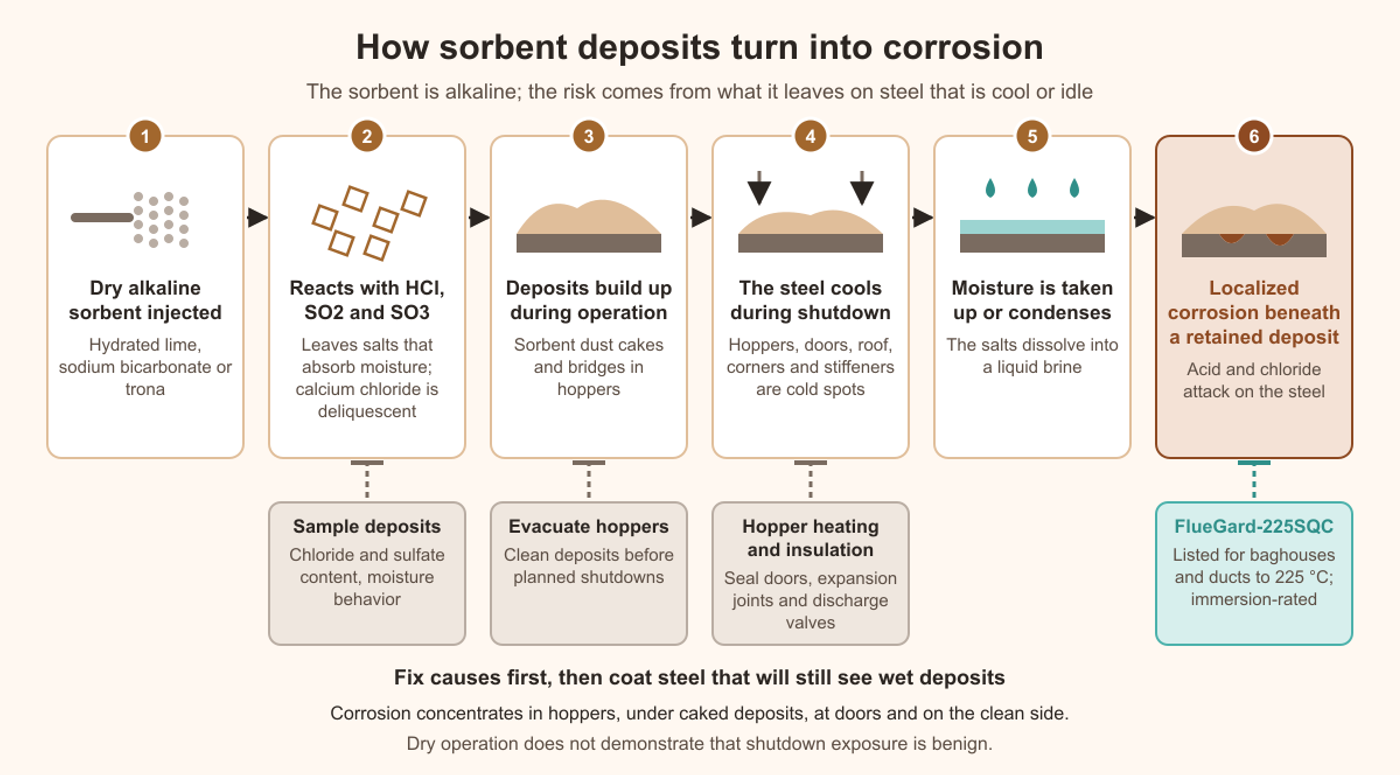
Polylloy's corrosion technical document sets out the sequence. Deposits build up during operation, the steel cools during shutdown, moisture is taken up or condenses, the salts dissolve, and localized corrosion develops beneath a retained deposit. The same document makes a point worth repeating: dry operation does not demonstrate that shutdown exposure is benign.
Hopper Caking and Condensation Under Sorbent Deposits
Hopper caking and condensation under sorbent deposits put the worst of the attack in predictable places.
Why Hoppers Go First
Hoppers are among the coldest, most deposit-prone steel in a baghouse. Moisture-absorbing sorbent dust cakes and bridges, holds moisture against hopper walls and valleys, and stays in place through shutdowns. Doors, the roof, corners and stiffeners are the other cold spots, along with any point where outside air leaks in.
The Clean Side Has No Buffer
On the dirty side of a cement baghouse, alkaline dust can partially neutralize acid condensate, while the clean-gas side largely lacks that buffering (International Cement Review (ICR), May 2026). With DSI, unreacted alkaline sorbent may buffer the dirty side, but chloride salts still attract moisture, and the clean side still sees acid condensate.
Injection-Point and Duct Wear from Sorbent Particles
Injection-point and duct wear from sorbent particles adds abrasion to the deposit problem.
Where Sorbent Abrades Steel
Injected powder and its carrier air abrade steel near the injection lances, at duct bends downstream and at hopper outlets. Abrasion strips protective films, which lets wet deposits reach fresh steel.
Where abrasion leads, a wear-rated grade is reviewed per zone by Polylloy's technical team: WearGard®-625S, whose bulletin lists high-temperature ducts in cement and lime and ducts in coal power and waste incineration, is not an immersion grade, so it suits dry wear zones rather than wet deposits.
Why Cement Plant Filters Fail Early with Sorbent and Acid Gas
Cement plant filters fail early when several changes stack up on the same steel.
Cement Filter Conditions That Shorten Steel Life
Cooler gas from waste heat recovery and emissions upgrades narrows the margin above the acid dew point, typically 120 to 160 °C in cement plant gas depending on SO3 and moisture (ICR, May 2026). Alternative fuels change chloride, sulfur and alkali inputs, according to Polylloy's technical document, and higher filtration removes the alkaline buffer on the clean side.
Add moisture-holding sorbent deposits and frequent shutdowns, and acid and chloride brine has time to sit on the steel. Whether a given cement plant uses DSI is plant-specific; the visible symptoms are listed in acid dew point corrosion warning signs.
How to Protect Baghouses and Ducts on a Dry Sorbent Injection System
Protecting baghouses and ducts on a dry sorbent injection system follows seven steps, causes first and coating last.
Step 1: Map Metal Temperatures and Cold Spots
Measure minimum wall temperatures in operation, at low load and through shutdown, and use thermography to find cold patches at hoppers, doors and seals. Compare them with the acid dew point, not only with the bulk gas temperature.
Step 2: Sample Deposits and Condensate
Sample hopper, wall and clean-side deposits for chloride and sulfate content and moisture behavior. Polylloy's technical document notes that these measurements are more useful than a material name or a bulk gas temperature.
Step 3: Fix Hopper Heating, Insulation and Air In-Leakage
Repair insulation and cladding, maintain hopper heating where it is fitted, and seal doors, expansion joints and discharge valves. False air cools steel locally (ICR).
Step 4: Evacuate Hoppers and Clean Deposits Before Shutdowns
Where practical, empty hoppers and remove caked deposits before planned shutdowns, so moisture-absorbing salts are not left on cooling steel. This is good practice rather than a fixed rule, and the right approach depends on the unit.
Step 5: Inspect Injection Zones and Bends for Wear
Take ultrasonic thickness readings at lances, downstream bends and hopper outlets at each outage. Separate wear-led loss from corrosion-led loss, because they call for different protection.
Step 6: Coat Steel That Will Still See Wet Deposits
FlueGard-225SQC is a two-component polymeric alloy, 100 % solids, rated to 225 °C (437 °F), and its bulletin lists baghouses, electrostatic precipitators (ESPs) and ducts in cement plants and waste incinerators. It resists SO3, SO2, HCl, carbon dioxide (CO2), hydrogen fluoride (HF) and nitrogen oxides (NOx), is abrasion resistant and immersion-rated, with Taber abrasion below 30 mg and adhesion above 3,000 psi (ASTM International D4541).
Final heat cured activation is completed during start-up using process heat, so start-up belongs in the outage plan. Grade data are on the FlueGard flue gas coatings page.
Surface preparation is an SSPC-SP10 / NACE No. 2 near-white blast (Society for Protective Coatings and NACE International standards) with a profile above 3 mils (75 µm), with soluble salts removed; chloride-laden steel needs washing and testing before coating. Certified partners apply; Polylloy formulates, supplies, specifies, trains and supervises.
Step 7: Inspect at Every Outage
Inspect hoppers, doors and the clean side first at every outage. The full routine is in the baghouse corrosion maintenance and inspection checklist.
Where a Coating is Not the Answer on a Sorbent Injection System
A coating is not the answer on a sorbent injection system in several cases:
- Steel already below structural minimum, which is repaired or replaced first.
- Zones above 225 °C, which need other grades or no coating.
- Filter bags, cages and the sorbent handling system itself, which are outside scope.
- Dry, ambient support steel and walkways, where a conventional coating is enough.
- Zones where an SSPC-SP10 blast or start-up activation cannot be achieved, which are not a fit.
A coating also does not remove the cause. Without cold-spot control and deposit management, wet deposits will keep forming.
Deciding on Corrosion Protection After Adding Dry Sorbent Injection
Deciding on corrosion protection after adding dry sorbent injection means weighing the evidence honestly and applying a few rules.
Evidence and Decision Rules
No DSI-specific Polylloy case study is published. The nearest field record is in other conditions: FlueGard on coal mill baghouses at three cement plants in Mexico, applied 2004, 2007 and 2008 and inspected after about 20, 15 and 16 years, with no issues observed, excellent condition and excellent performance reported.
Only the 2008 unit is specifically FlueGard-225SQC; the detail is in the coal baghouse coating service record. The decision rules follow from the steps:
- Map metal temperatures and sample deposits first.
- Fix cold spots and hopper practice.
- Coat hoppers, the clean side and duct low points that still see wet deposits with FlueGard-225SQC within 225 °C.
- Review wear-led zones for WearGard-625S.
- Keep mild zones on conventional coatings.
Linings, alloys and corrosion allowance are covered in the post-upgrade options linked above, and the wider plant view is in air pollution control equipment corrosion protection.
Cost and Next Step
Pricing depends on the operating environment, selected coating system, equipment condition, project size, and application requirements. Lifecycle evaluation considers preparation, application, maintenance, downtime, and replacement alongside the initial material cost.
To book a Coating Performance Review, request a coating evaluation with equipment type, coated area, sorbent type, gas temperatures (normal, low load, shutdown), gas chemistry, deposit analysis, location and outage timing.
FAQs
Does Dry Sorbent Injection Cause Baghouse Corrosion?
It can. The sorbent is alkaline, but its reactions with acid gases leave salts that absorb moisture, and calcium chloride from lime-based sorbents is deliquescent. On cool hoppers, doors and clean-side steel, and during shutdowns, those deposits form a corrosive film beneath them. Cold-spot control, deposit management and a suitable coating reduce the risk.
Why Do Baghouse Hoppers Corrode After Sorbent Injection is Added?
Hoppers are among the coldest and most deposit-prone steel in a baghouse. Moisture-absorbing sorbent dust cakes on hopper walls and valleys, holds moisture against the steel and stays in place through shutdowns. Hopper heating, insulation, sealing and emptying hoppers before shutdowns help, and steel that still sees wet deposits is coated.
Which Sorbents Are Used in Dry Sorbent Injection?
The common sorbents are hydrated lime, sodium bicarbonate and trona, injected as dry powder ahead of the baghouse to react with acid gases such as hydrogen chloride and sulfur oxides. The choice of sorbent changes which salts deposit, so deposit sampling, not the sorbent name, tells you how corrosive the residues will be.
Why Do Cement Plant Filters Fail Early?
Several changes stack up: cooler gas narrows the margin above an acid dew point of typically 120 to 160 °C in cement plant gas, alternative fuels add chlorides, and better filtration leaves the clean side without alkaline dust to buffer condensate. Moisture-holding deposits and frequent shutdowns then let acid and chloride brine sit on the steel.
What Coating Protects a Baghouse from Hygroscopic Deposits?
A coating rated for the gas chemistry, the condensate and the baghouse temperature. FlueGard-225SQC is listed for baghouses and ducts to 225 °C, resists HCl, SO2 and SO3, and is immersion-rated for wet deposits. It needs an SSPC-SP10 blast, and final heat cured activation is completed during start-up using process heat.
Can Insulation Alone Stop Corrosion from Sorbent Deposits?
Usually not. Insulation, hopper heating and sound seals keep steel warmer in operation and limit false air, but deposits keep absorbing moisture when the unit cools at shutdown. Insulation alone does not address shutdown moisture, so steel that still sees wet deposits is evaluated for a coating as well.

Edita Rojasova
Co-founder and Chief Technology Officer, Polylloy Coatings
Edita Rojasova is co-founder and Chief Technology Officer of Polylloy Coatings, Inc., which develops hybrid polymer-alloy-ceramic technologies that protect industrial equipment in extreme environments against high-temperature corrosion, chemical attack, and abrasion. A materials scientist educated at the Slovak University of Technology in Bratislava, she holds a master’s degree in chemical engineering and fuel processing and a PhD in organic technology, with a focus on catalysis and the modification of inorganic substrates. She brings expertise in both organic and inorganic chemistry, integrating the two into true hybrid protective systems. Her specializations include electrochemistry, corrosion mechanisms of metallic substrates, and the chemistry of the substrate–coating interface. An inventor with multiple U.S. patents, she leads Polylloy’s R&D, guiding new formulations from testing and characterization through to field implementation.
Related Signals
Ammonia Slip After SNCR or SCR: Ammonium Salt Corrosion in Ducts and Baghouses
Edita RojasovaFri, Nov 6, 2026