Ammonia Slip After SNCR or SCR: Ammonium Salt Corrosion in Ducts and Baghouses
 Edita RojasovaLast Updated: Nov 18, 2026
Ammonia Slip Corrosion: Key Points
- Ammonia slip from selective non-catalytic reduction (SNCR) or selective catalytic reduction (SCR) can cause corrosion, mostly indirectly: unreacted ammonia combines with sulfur trioxide and hydrogen chloride to form ammonium salts.
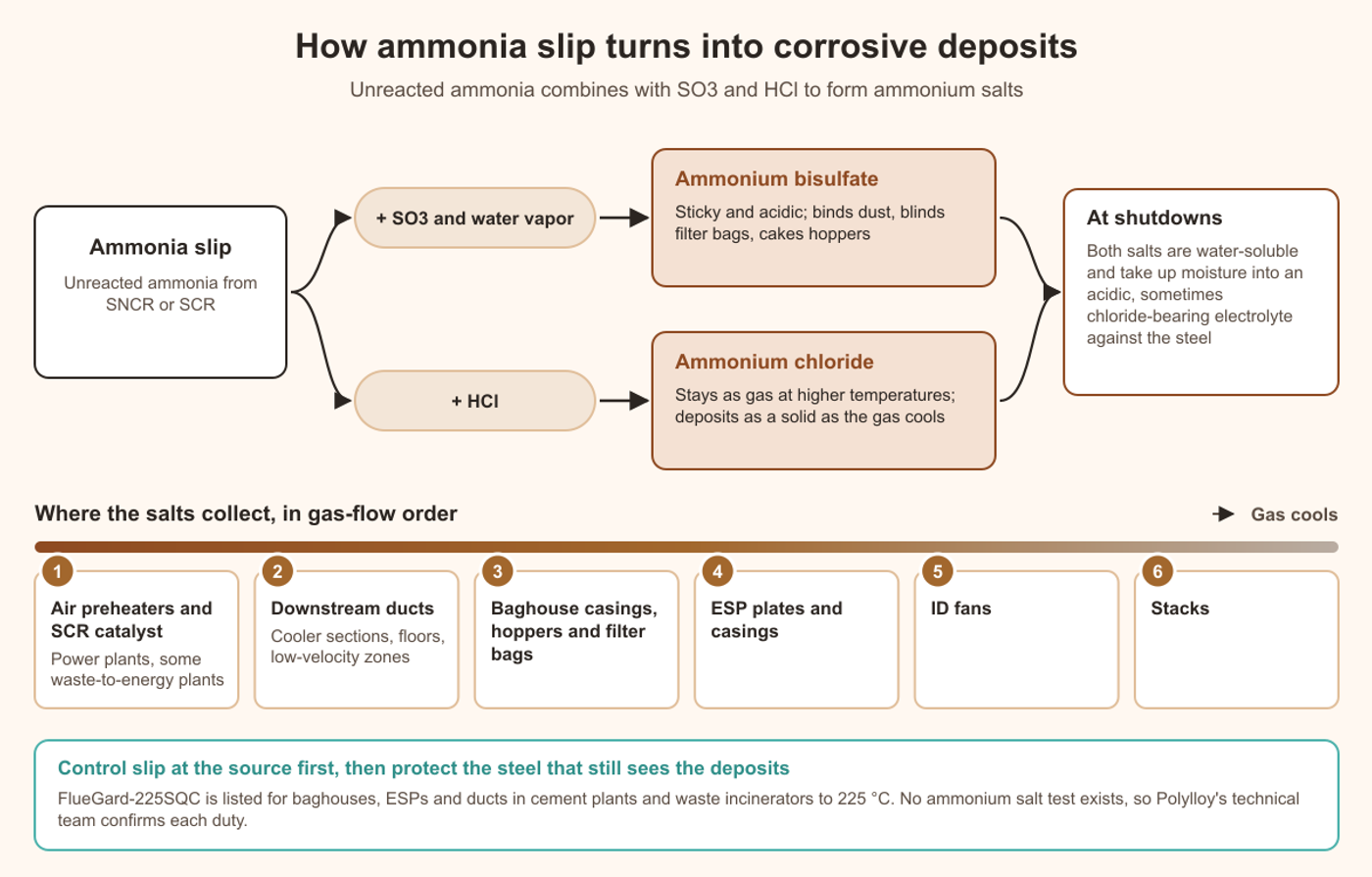
- With sulfur trioxide and water vapor, ammonia forms ammonium bisulfate, a sticky, acidic deposit; with hydrogen chloride it forms ammonium chloride, which deposits as a solid as gas cools.
- Sticky ammonium bisulfate in particular binds dust, blinds filter bags and cakes hoppers, and both salts are water-soluble, so at shutdowns they take up moisture into an acidic, sometimes chloride-bearing electrolyte against the steel.
- They collect where gas cools: air heaters and SCR catalyst in power plants, then ducts, baghouse casings and hoppers, fans and stacks.
- Control starts at the source: injection temperature and mixing, ammonia dosing, slip monitoring, sulfur trioxide and hydrogen chloride control, and removing deposits before long outages.
- Where steel still sees the deposits, FlueGard®-225SQC is listed for baghouses, electrostatic precipitators (ESPs) and ducts in cement plants and waste incinerators to 225 °C; no ammonium salt test exists, so Polylloy's technical team confirms each duty.
Ammonia slip from SNCR can cause corrosion, mostly indirectly. Unreacted ammonia combines with sulfur trioxide to form sticky, acidic ammonium bisulfate and with hydrogen chloride to form ammonium chloride. Both deposit in cooler ducts and baghouses, bind dust and take up moisture at shutdowns, holding an acidic electrolyte against the steel.
Ammonia Slip from SNCR and SCR and Why It Matters for Steel
Ammonia slip matters for steel because of what the ammonia forms downstream, not because of the ammonia itself.
What Ammonia Slip Is
Ammonia slip corrosion is attack on flue gas path steel driven by unreacted ammonia from SNCR or SCR control of nitrogen oxides (NOx). The ammonia combines with sulfur trioxide (SO3) and hydrogen chloride (HCl) to form ammonium bisulfate and ammonium chloride deposits that hold acid and moisture against ducts, baghouses and other equipment.
SNCR injects ammonia or urea into hot gas without a catalyst: in cement, typically in the preheater riser or calciner, and in waste-to-energy plants, in the furnace. SCR reduces NOx over a catalyst at lower gas temperatures. Slip is the ammonia that does not react and travels downstream with the gas.
Why Slip Matters for Corrosion
Ammonia on its own is not the main corrosion agent for flue gas steel. The problem is what it forms with SO3 and HCl and where those salts deposit, and the extent depends on slip level, SO3 and HCl content and the temperature profile downstream.
How Ammonium Bisulfate Forms and Why It Corrodes
Ammonium bisulfate is the salt that links ammonia slip to the sulfur chemistry already present in the gas.
Formation of Ammonium Bisulfate
Ammonia, SO3 and water vapor react to form ammonium bisulfate (ABS), and at different ratios ammonium sulfate. Polylloy's May 2026 International Cement Review (ICR) article explains where the SO3 comes from: sulfur enters mainly as sulfur dioxide (SO2), and a portion oxidizes to SO3 with oxygen and catalysts such as iron oxides and alkalis.
The same SO3 that raises the acid dew point, typically to 120 to 160 °C in cement plant flue gas according to the ICR article, is the SO3 available to ammonia. ABS deposits within a temperature band that depends on the ammonia and SO3 levels in the gas.
Why Ammonium Bisulfate Attacks Steel
ABS is acidic and highly water-soluble. As a sticky deposit it binds fly ash or kiln dust into a dense layer on the steel, and when it takes up moisture it forms an acidic electrolyte under that layer.
The classic case is ABS fouling and corrosion in coal-fired power plant air preheaters downstream of SCR; the wider power flue path is covered in power plant corrosion protection.
How Ammonium Chloride Forms and Where It Deposits
Ammonium chloride is the second ammonium salt, and it follows the chlorine in the gas.
Formation of Ammonium Chloride
Ammonia and HCl form ammonium chloride, which stays as gas at higher temperatures and deposits as a solid as the gas cools. Chlorine-rich gas makes it more likely, as in waste-to-energy flue gas and kilns co-processing alternative fuels; chloride sources in that sector are covered in waste-to-energy plant corrosion protection.
Why Ammonium Chloride Deposits Matter
Ammonium chloride is water-soluble, so at shutdowns it can dissolve into a chloride-bearing, mildly acidic solution on the steel. Chloride solutions attack carbon steel and pit stainless steel, as explained in why 316 stainless corrodes in flue gas.
Where Ammonium Salts Collect in Ducts, Baghouses and Stacks
Ammonium salts collect wherever the gas cools into their deposition range, from the air preheater to the stack.
Locations Along the Gas Path
In gas-flow order, ammonium salts collect in these locations:
- Air preheaters and SCR catalyst, in power plants and some waste-to-energy plants.
- Downstream ducts, especially cooler sections, floors and low-velocity zones.
- Baghouse casings, hoppers and filter bags.
- ESP plates and casings.
- Induced draft (ID) fans.
- Stacks.
In the baghouse, sticky salts blind bags, raise pressure drop and cake in hoppers. Caked deposits are where corrosion tends to start at shutdown.
Cement and Waste-to-Energy Context
In cement, SNCR in the preheater or calciner sends slip through the conditioning tower, the raw mill when it runs, the main filter and the stack. In waste-to-energy, SNCR sits in the furnace, and some plants add a tail-end SCR after the filter with gas reheating; chlorine-rich gas there favors ammonium chloride.
Baghouse filters corrode after emissions upgrades because cooler gas and higher-efficiency filtration leave more steel near the acid dew point and less alkaline dust on the clean side, as the ICR article explains. Where NOx control was added, ammonium salts deposit on the casing and bags as well; the condensation symptoms are listed in the acid dew point warning signs.
Why Ammonium Salt Deposits Attack Steel at Shutdowns
Ammonium salt deposits often do much of their damage when the plant cools down.
The Shutdown Sequence with Ammonium Salts
Polylloy's technical paper on stainless steels and claddings notes that dust and ash can concentrate soluble salts, retain moisture and create shielded locations. Its typical sequence is deposition during operation, cooling during shutdown, moisture uptake or condensation, salt dissolution, and localized corrosion beneath a retained deposit; dry operation does not demonstrate that shutdown exposure is benign.
Ammonium salts are that kind of soluble deposit, so the same sequence can apply. Emissions controls created an acid condensation problem because cooling the gas narrowed the margin to the acid dew point and better filtration removed alkaline buffering, and ammonia-based NOx control added a deposit route on top. In Polylloy's view, the industry solved one emissions problem and created a corrosion one.
Controlling Ammonia Slip and Ammonium Salt Formation
Controlling ammonia slip and ammonium salt formation works first at the injection point and then at the steel.
At the Source
The source-side controls for ammonia slip are:
- Inject within the system's temperature window, with good mixing and coverage across the duct.
- Dose ammonia or urea to the NOx demand rather than in excess.
- Monitor slip continuously with a suitable analyzer so dosing can respond.
- Keep SCR above its minimum operating temperature, below which ABS can foul the catalyst.
In the Gas and at the Steel
Reduce the species ammonia reacts with: SO3 and HCl control, where installed, limits the salts that slip can form. At critical equipment, keep metal temperatures out of the deposition band where practical, with insulation and seal repair, remove deposits before long outages and evacuate hoppers.
Washing needs care: water dissolves ammonium salts into an acidic solution, so any wash should be followed by drying and inspection.
Protecting Ducts and Baghouses That Still See Ammonium Salts
Protecting ducts and baghouses that still see ammonium salts means a barrier on the steel, chosen within its published listing.
FlueGard-225SQC and What Its Bulletin Covers
FlueGard-225SQC is a two-component polymeric alloy listed for baghouses, ESPs and ducts in cement plants and waste incinerators, rated to 225 °C (437 °F), and resistant to SO3, SO2, HCl, carbon dioxide (CO2), hydrogen fluoride (HF) and NOx. Its bulletin makes no claim about ammonium salt deposits or deposit build-up.
The bulletin's acid immersion data are not ammonium salt data: one-week immersion weight gain below 1.0 % in 37 % HCl and below 0.5 % in 36 % sulfuric acid (H2SO4), tested to ASTM International method D471. Polylloy's own test found no observed deterioration after six months in 56 % H2SO4 at 60 °C, and the grade is immersion-rated.
No Polylloy test in ammonium bisulfate or ammonium chloride exists, so each duty is confirmed by Polylloy's technical team. Grade data are on the FlueGard flue gas coatings page.
Delivery and the Wider Options
Certified partners apply the coating, while Polylloy formulates, supplies, specifies, trains and supervises. Surface preparation is SSPC-SP10 (Society for Protective Coatings) / NACE No. 2 near-white with a profile above 3 mils (75 µm) and soluble salts removed, and final heat cured activation is completed during start-up using process heat.
Other routes are compared in corrosion protection options after an emissions upgrade, and the equipment walk-through is in air pollution control corrosion protection.
Deciding Whether Ammonia Slip is Your Corrosion Problem
Deciding whether ammonia slip is the corrosion problem starts with three signs:
- New sticky deposits or bag blinding after NOx control was added or tuned.
- Deposits that test positive for ammonium together with sulfate or chloride.
- Corrosion concentrated under those deposits.
If the signs fit, fix slip first, then protect the steel that still sees deposits; if no ammonium is found, look at dew point and filtration causes instead. Steel that stays dry and above the deposition band may need only a conventional coating.
To check your case, book a Coating Performance Review with deposit analysis, NOx control type and slip data, equipment type, coated area, operating conditions, location and outage timing.
FAQs
Does Ammonia Slip from SNCR Cause Corrosion?
It can, mostly indirectly. Unreacted ammonia combines with sulfur trioxide to form ammonium bisulfate and with hydrogen chloride to form ammonium chloride. Both deposit as gas cools in ducts and baghouses, bind dust and take up moisture at shutdowns, holding an acidic, sometimes chloride-bearing solution against the steel; the risk rises with slip level and SO3 or HCl content.
What is Ammonium Bisulfate and Why is It a Problem?
Ammonium bisulfate is a salt formed from ammonia, sulfur trioxide and water vapor in flue gas downstream of NOx control. Within a temperature band it deposits as a sticky, acidic material that binds dust, can foul air preheaters and catalyst, can blind filter bags and, once it takes up moisture, can corrode the steel beneath the deposit.
Why Do Baghouse Filters Corrode After Emissions Upgrades?
Upgrades often cool the gas and improve filtration, so more steel runs near the acid dew point and less alkaline dust reaches the clean side to neutralize condensate. Where NOx control was added, ammonia slip adds ammonium salt deposits on casings, hoppers and bags, which absorb moisture at shutdowns and attack the steel beneath them.
Why Did Emissions Controls Create an Acid Condensation Problem?
Cooling flue gas to cut emissions and recover heat narrowed the margin between operating temperature and the acid dew point, and high-efficiency filters removed the alkaline dust that used to neutralize condensate. Ammonia-based NOx control added another route through ammonium salt deposits. In Polylloy's view, the industry solved one emissions problem and created a corrosion one.
What Corrosion Protection is Needed After an Emissions Control Upgrade?
Start by mapping new metal temperatures, deposits and any ammonia slip, then fix cold spots, seals and slip at the source. Protect the steel that still sees condensate or deposits with a grade matched to its temperature: FlueGard-225SQC is listed for baghouses, ESPs and ducts in cement plants and waste incinerators to 225 °C, confirmed per duty.
Can Ammonium Chloride Deposits Corrode Stainless Steel?
Yes, where they get wet. Ammonium chloride is water-soluble, so moisture at shutdown turns a deposit into a chloride-bearing solution on the metal. Chlorides are a main cause of pitting and crevice corrosion in austenitic stainless steels such as 316, so a stainless duct or filter casing is not automatically safe from ammonium chloride.
How Do You Reduce Ammonia Slip from SNCR?
Inject ammonia or urea within the system's effective temperature window, improve mixing and coverage across the duct, dose to the actual NOx demand instead of in excess, and monitor slip continuously so dosing can respond. Reducing sulfur trioxide and hydrogen chloride in the gas also limits the salts that slip can form downstream.

Edita Rojasova
Co-founder and Chief Technology Officer, Polylloy Coatings
Edita Rojasova is co-founder and Chief Technology Officer of Polylloy Coatings, Inc., which develops hybrid polymer-alloy-ceramic technologies that protect industrial equipment in extreme environments against high-temperature corrosion, chemical attack, and abrasion. A materials scientist educated at the Slovak University of Technology in Bratislava, she holds a master’s degree in chemical engineering and fuel processing and a PhD in organic technology, with a focus on catalysis and the modification of inorganic substrates. She brings expertise in both organic and inorganic chemistry, integrating the two into true hybrid protective systems. Her specializations include electrochemistry, corrosion mechanisms of metallic substrates, and the chemistry of the substrate–coating interface. An inventor with multiple U.S. patents, she leads Polylloy’s R&D, guiding new formulations from testing and characterization through to field implementation.
Related Signals
Dry Sorbent Injection and Corrosion: Hygroscopic Deposits in Baghouses and Ducts
Edita RojasovaSat, Nov 7, 2026