
Chloride Bypass Corrosion in Cement Plants: Bypass Ducts, Quench and Filter
 Surjit GillLast Updated: Nov 18, 2026
Chloride Bypass Corrosion: Key Points
- Chloride bypass corrosion follows the gas from the kiln inlet probe through the quench, ducts, dust filter and fan to the stack, and each zone needs its own answer.
- The probe, extraction duct and hot end of the quench chamber typically run above every coating service limit, so refractory and heat-resistant alloy stay the answer there.
- Below those zones, Polylloy bulletins list cement duty for FlueGard®-225SQC (baghouses, ducts, 225 °C), FlueGard-425S (conditioning towers, stacks, 425 °C), WearGard®-625S (hot ducts, 625 °C) and StackGard®-255SQW (chimneys, 255 °C).
- Bypass dust is rich in alkali chlorides and pulls in moisture at cold spots and during stops, so filter hoppers, duct floors and the clean-gas side corrode first.
- No bulletin lists quench chambers, so wetted quench steel is reviewed case by case by Polylloy's technical team, considering only immersion-rated FlueGard-225SQC or CorrosionGard®-160S; no chloride bypass case study has been published.
- Certified partners apply the coatings; Polylloy formulates, supplies, specifies, trains and supervises.
Protect a cement chloride bypass zone by zone: the probe, extraction duct and hot quench run above every coating limit and stay with refractory and alloy. Cooler bypass ducts and the dust filter take FlueGard-225SQC (225 °C), hot abrasive ducts WearGard-625S (625 °C) and the stack StackGard-255SQW (255 °C), with wetted quench steel reviewed case by case.
Chloride Bypass Corrosion Challenges Matched to Protection
Chloride bypass corrosion is the attack on steel in a cement kiln chloride bypass, from the extraction probe and quench through the ducts, dust filter and fan to the stack, by the alkali chloride dust, acid gas and condensate the bypass removes from the kiln. Each zone fails in its own way.
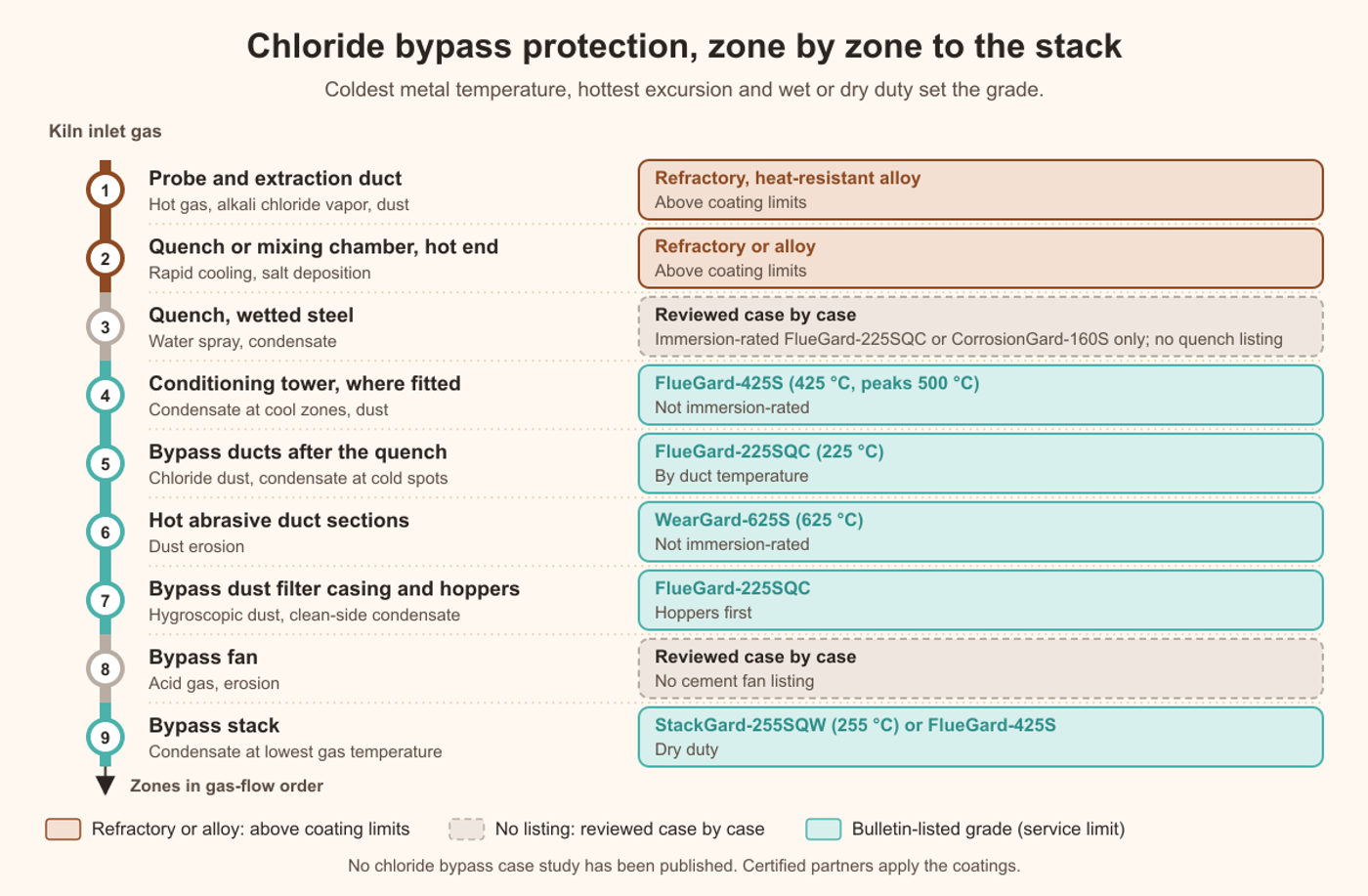
Challenge vs Solution Table by Bypass Zone
The zones, in gas-flow order:
| Zone | Main attack | Protection (service limit) | Note |
|---|---|---|---|
| Probe and extraction duct | Hot gas, alkali chloride vapor, dust | Refractory, heat-resistant alloy | Above coating limits |
| Quench or mixing chamber, hot end | Rapid cooling, salt deposition | Refractory or alloy | Above coating limits |
| Quench, wetted steel | Water spray, condensate | Reviewed case by case; immersion-rated FlueGard-225SQC or CorrosionGard-160S only | No quench listing |
| Conditioning tower, where fitted | Condensate at cool zones, dust | FlueGard-425S (425 °C, peaks 500 °C) | Not immersion-rated |
| Bypass ducts after the quench | Chloride dust, condensate at cold spots | FlueGard-225SQC (225 °C) | By duct temperature |
| Hot abrasive duct sections | Dust erosion | WearGard-625S (625 °C) | Not immersion-rated |
| Bypass dust filter casing and hoppers | Hygroscopic dust, clean-side condensate | FlueGard-225SQC | Hoppers first |
| Bypass fan | Acid gas, erosion | No cement fan listing | Reviewed case by case |
| Bypass stack | Condensate at lowest gas temperature | StackGard-255SQW (255 °C) or FlueGard-425S | Dry duty |
Coldest metal temperature, hottest excursion and wet or dry duty set the grade. The rest of the plant is mapped under cement plant corrosion protection.
Why a Chloride Bypass Concentrates Corrosive Salts
The bypass exists to remove salts, so its steel receives them.
Alkali Chloride Circulation and the Bypass
Chlorine, potassium and sodium tend to volatilize in the hot zone of the kiln and condense again in the cooler preheater, building a circulation that can cause build-ups. A bypass bleeds part of the kiln inlet gas out to break that cycle, cooling it quickly so alkali chlorides solidify on the dust that the bypass filter then separates.
Alternative Fuels Raise the Chloride Load
Refuse-derived and other waste-derived fuels add variable chlorine, sulfur and alkali, so bypass capacity often rises with substitution rates; see alternative fuel corrosion protection options and how alternative fuels changed kiln corrosion. Polylloy's KilnGard-600SCW bulletin records that with increased use of alternative fuels, kiln shell corrosion under the refractory is more severe.
Hygroscopic Dust, Condensate and Stops
Chloride-rich dust absorbs moisture at cold spots and during stops and can form a corrosive brine on steel even when the bulk gas is dry. Acid condensate carrying sulfur trioxide (SO3) and hydrogen chloride (HCl) can form where steel runs below the acid dew point, often at cold spots created by air in-leakage.
Bypass Probe, Extraction Duct and Quench Chamber: Where Coatings Stop
The front of the bypass belongs to refractory and alloy.
Hot Extraction Zones Need Refractory and Alloy
The extraction probe, the kiln inlet duct and the hot end of the quench or mixing chamber typically carry gas far hotter than the highest Polylloy service limit, 625 °C for WearGard-625S. They stay with refractory linings and heat-resistant alloys selected by the bypass designer.
KilnGard-600SCW is not offered for chloride bypass equipment: its bulletin lists, beneath refractory, rotating kilns in cement and clay manufacturing, industrial furnaces in waste incineration plants and smelter ducts, filters and stacks.
Wetted Quench Steel and Immersion
Where the quench uses water sprays, steel downstream of the spray zone sees wetting and drying with chloride salts. Only FlueGard-225SQC (225 °C) and CorrosionGard-160S (160 °C) are immersion-rated; the other grades are not.
No Polylloy bulletin lists quench or mixing chambers, so each wetted zone is reviewed case by case by Polylloy's technical team from its metal temperature and chemistry. An air-only quench is a dry hot zone, and the downstream duct grade follows metal temperature.
Bypass Ducts After the Quench: Corrosion and Hot Abrasion
Ducts are matched by metal temperature, then dust load.
FlueGard-225SQC for Bypass Ducts
FlueGard-225SQC is a two-component polymeric alloy rated to 225 °C (437 °F), resistant to SO3, sulfur dioxide (SO2), HCl, carbon dioxide (CO2), hydrogen fluoride (HF) and nitrogen oxides (NOx). Its bulletin lists ducts in cement plants, with Taber abrasion below 30 mg and adhesion above 3,000 psi (ASTM International D4541), and it is immersion-rated.
Cold spots sit at duct floors, flanges, stiffeners, expansion joints and dampers, so insulation and air-leak sealing go with the coating; see FlueGard flue gas coatings.
WearGard-625S Where Dust Erodes the Duct
WearGard-625S is a two-component nano-ceramic abrasion-resistant material rated to 625 °C (1,157 °F), with Taber abrasion below 30 mg, Shore D above 95 and adhesion above 1,000 psi (ASTM D4541). Its bulletin lists high temperature ducts in cement and lime manufacturing as equipment exposed to hot severe abrasion.
It is not immersion-rated, so where condensate forms it is paired with an acid-resistant grade or confined to bends and impingement zones.
Conditioning Towers Where the Bypass Has One
FlueGard-425S is a single-component inorganic polymeric coating with reactive fillers, rated from ambient to 425 °C (797 °F) with peaks to 500 °C and Taber abrasion below 150 mg. Its bulletin lists conditioning towers and stacks in cement and lime plants; it is not immersion-rated, so continuously wetted tower zones are confirmed per zone.
Bypass Dust Filter and Hoppers
The bypass filter collects the chloride-rich dust.
Where the Bypass Filter Corrodes First
Hoppers, valley angles, doors, the roof and the clean-gas plenum are the first places to inspect. Hoppers run coolest and hold dust longest, and every stop takes damp dust through the dew point.
FlueGard-225SQC is the bulletin grade, listed for baghouses, electrostatic precipitators (ESPs) and ducts in cement plants. Hopper heating, insulation and door seals belong in the same plan; unit detail is under air pollution control equipment.
Nearest Cement Filter Evidence
FlueGard on coal mill baghouses at three cement plants in Mexico, applied in 2004, 2007 and 2008, was inspected after about 20, 15 and 16 years with no issues observed; only the 2008 unit is specifically FlueGard-225SQC. Coal mill filters do not see bypass chloride dust, so this is context, not proof.
Bypass Fan and Stack at the End of the Bypass
The fan and stack sit at the cool, condensing end.
Bypass Fan
No Polylloy bulletin lists fans in cement plants. FlueGard-225SQC has about 24 months on a cement plant fan housing in France exposed to HF, HCl, sulfur oxides and high-velocity dust, but that is a case record, not a listing.
A bypass fan is reviewed case by case by Polylloy's technical team; fan housing choices are compared in ID fan housing protection options.
Bypass Stack
StackGard-255SQW is rated to 255 °C (491 °F), and its bulletin covers the inside surfaces of steel chimneys connected to baghouses, ESPs and ducts in cement plants; it is not immersion-rated. FlueGard-425S also lists cement and lime stacks for hotter flues; see StackGard chimney coating. Final heat cured activation is completed during start-up using process heat.
What is and is Not Proven for Chloride Bypass Service
The evidence base is still short.
Bulletin Listings, Not Bypass Results
No chloride bypass case study has been published. The cement listings above are bulletin applications; performance detail for a bypass is provided by Polylloy's technical team for the project under review.
316 stainless steel is not automatically safe: Polylloy's technical paper notes that molybdenum improves 316L against 304L without immunity to pitting and crevice corrosion. Protected carbon steel may offer a cost-effective alternative to stainless steel where the coating is suitable for the specified service conditions.
How to Choose Chloride Bypass Corrosion Protection Zone by Zone
Choosing chloride bypass protection follows the gas path.
Decision Rules
Apply these rules per zone:
- Probe, extraction duct and hot quench: refractory and alloy.
- Wetted quench steel and the bypass fan: reviewed case by case by Polylloy's technical team, with immersion-rated grades only for wetted steel.
- Dry bypass ducts and the dust filter to 225 °C: FlueGard-225SQC.
- Hot abrasive duct sections: WearGard-625S.
- Conditioning tower and hotter stacks: FlueGard-425S; stacks to 255 °C: StackGard-255SQW.
- Dry, ambient support steel away from bypass dust: a conventional coating.
Inputs, Fit and Next Step
Inputs per zone: continuous, minimum and excursion metal temperatures, quench medium (air or water), dust chloride content (lab analysis), HCl and SO2, dust load and stop frequency.
Every grade needs a Society for Protective Coatings (SSPC) SP10 near-white blast with a profile above 3 mils (75 µm). Heat-cured grades (FlueGard, StackGard, WearGard) fit only where final heat cured activation can be completed during start-up using process heat, checked for bypass ducts and filters that run cool or intermittently; CorrosionGard-160S cures at ambient.
Certified partners apply the coatings; Polylloy formulates, supplies, specifies, trains and supervises (Polylloy corrosion protection solutions). Pricing depends on the operating environment, selected coating system, equipment condition, project size, and application requirements. To map your bypass, request a coating evaluation with the bypass zone, coated area, metal temperatures, quench medium, dust analysis, location and outage timing.
FAQs
How Do You Protect a Cement Chloride Bypass System from Corrosion?
Zone by zone: the probe, extraction duct and hot quench run above every coating limit and stay with refractory and alloy. Cooler bypass ducts and the dust filter suit FlueGard-225SQC to 225 °C, hot abrasive ducts WearGard-625S, and the stack StackGard-255SQW. Wetted quench steel is reviewed case by case, immersion-rated grades only.
Why Does Chloride Bypass Dust Corrode Steel So Quickly?
Bypass dust carries the alkali chlorides the bypass removes from the kiln, and chloride salts absorb moisture. At cold spots and during stops the damp dust can form a chloride brine on the steel, while acid condensate forms where metal runs below the acid dew point.
Can a Chloride Bypass Probe or Quench Chamber Be Coated?
The probe, extraction duct and hot quench usually run hotter than any Polylloy service limit, so they stay with refractory and alloy. Where water sprays wet the steel downstream, only immersion-rated FlueGard-225SQC or CorrosionGard-160S is considered, and because no bulletin lists quench chambers, each zone is reviewed case by case by Polylloy's technical team.
What Coating Suits a Chloride Bypass Dust Filter?
FlueGard-225SQC is the bulletin grade for baghouses, electrostatic precipitators and ducts in cement plants, rated to 225 °C and resistant to hydrogen chloride, sulfur oxides and hydrogen fluoride. Hoppers, valley angles, doors and the clean-gas plenum come first, and insulation, hopper heating and door seals reduce condensation.
Does Burning More Alternative Fuel Make Bypass Corrosion Worse?
Often, because refuse-derived and other waste-derived fuels add variable chlorine, sulfur and alkali to the kiln, and the bypass then removes more chloride-rich dust. More chloride in the dust means more hygroscopic deposits on duct and filter steel. Sample the dust and record metal temperatures before choosing protection, since fuel batches vary.
Who Applies Coatings on a Cement Chloride Bypass?
Certified Polylloy application partners prepare the steel to SSPC-SP10 near-white and apply the coating during a planned outage. Polylloy formulates, supplies, specifies the grade per zone, trains applicators and supervises. Final heat cured activation is completed during start-up using process heat, so the start-up plan is part of the job.

Surjit Gill
Co-founder, Polylloy Coatings
Surjit Gill is co-founder of Polylloy Coatings, which develops innovative hybrid coatings to protect industrial equipment against high-temperature corrosion, chemical attack, and abrasion in severe-service applications worldwide. Trained in chemical engineering and business management, he brings leadership experience spanning startup incubation and business growth. He focuses on commercializing materials innovation, scaling organizations, and advancing go-to-market strategy through global partnerships.
Related Signals
Smelter Corrosion Protection: Off-Gas Ducts, Filters, Stacks and Structures
Surjit GillThu, Nov 12, 2026
Phosphate Fertilizer Plant Corrosion Protection: Tanks, Vessels and Scrubber Ducts
Surjit GillWed, Nov 11, 2026
Biomass Boiler Corrosion Protection: Alkali Chlorides in Ducts, Baghouses and Stacks
Surjit GillTue, Nov 10, 2026