
Smelter Corrosion Protection: Off-Gas Ducts, Filters, Stacks and Structures
 Surjit GillLast Updated: Nov 12, 2026
Smelter Corrosion Protection: Key Points
- Smelter corrosion protection is set equipment by equipment: off-gas ducts, baghouses and filters, scrubbers, stacks, refractory-lined ducts and stacks, furnace shells, and structures and vessels each fail differently.
- Polylloy bulletins list smelter duty for six grades: FlueGard®-225SQC (225 °C), FlueGard-425S (425 °C, peaks 500 °C), StackGard®-255SQW (255 °C), KilnGard®-600SCW (600 °C, beneath refractory), WearGard®-625S (625 °C, hot abrasion) and CorrosionGard®-160S (160 °C, structures and vessels).
- FlueGard-225SQC is the one grade whose bulletin names battery recycle plants, for ducts, filters and stacks.
- No bulletin lists smelter furnace shells, converters, acid plants or sulfur dioxide recovery equipment; a furnace shell is reviewed furnace by furnace by Polylloy's technical team.
- No smelter or battery recycling case study has been published; the smelter listings are bulletin applications, not field results.
- Certified partners apply the coatings; Polylloy formulates, supplies, specifies, trains and supervises.
Smelter corrosion protection matches a bulletin-listed coating to each piece of equipment: FlueGard-225SQC or FlueGard-425S for off-gas ducts and filters, StackGard-255SQW for chimneys, KilnGard-600SCW beneath refractory, WearGard-625S where hot dust abrades and CorrosionGard-160S for structures and vessels. No bulletin lists smelter furnace shells, so each is reviewed per furnace.
Smelter corrosion protection is the selection of coatings, linings and operating measures that keep the steel in a copper, zinc or lead smelter's off-gas path, refractory-lined equipment and surrounding structures from acid gas, acid condensate, dust abrasion and heat, matched to each piece of equipment.
Smelter Corrosion Challenges Matched to Polylloy Grades
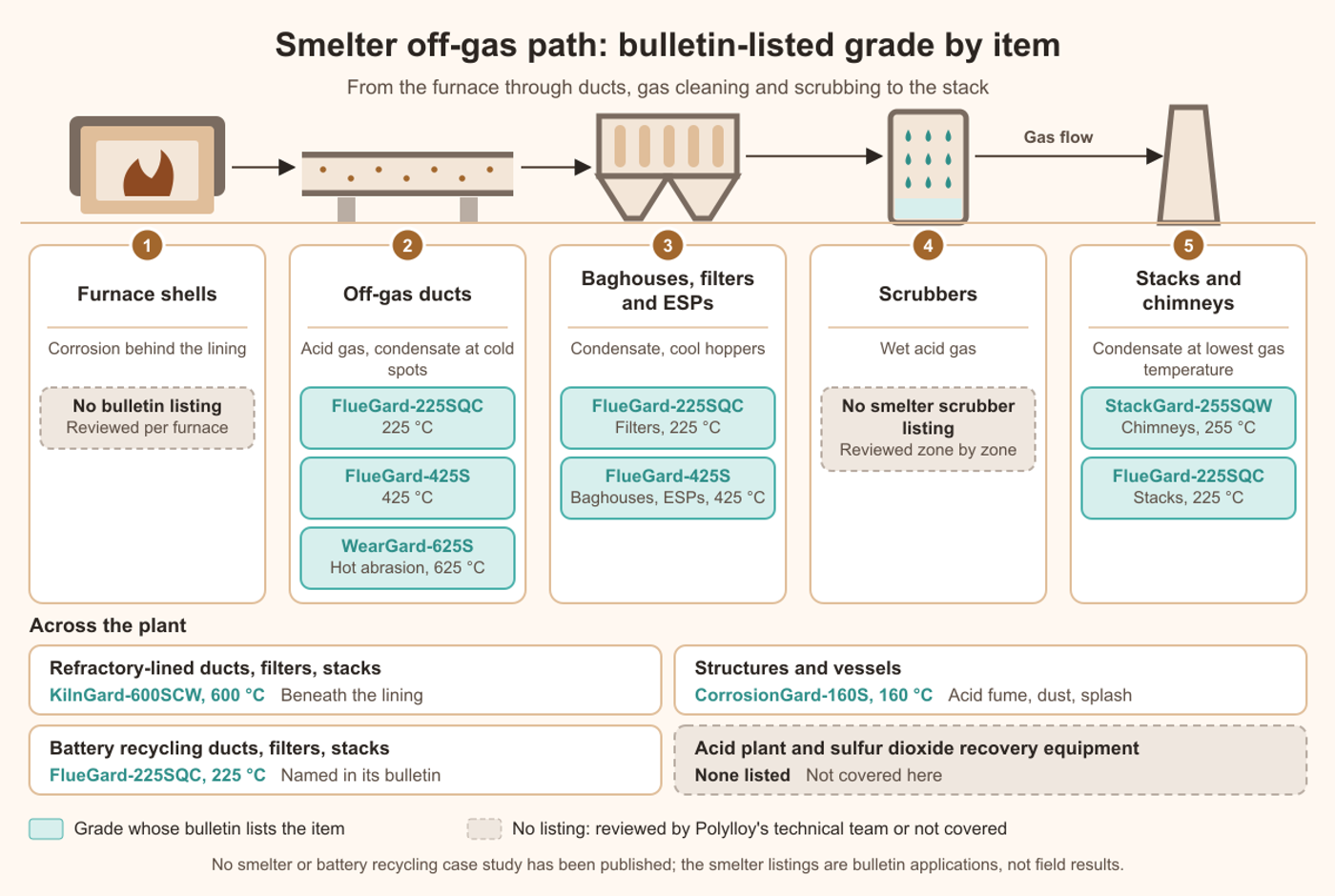
The smelter off-gas path runs from the furnace through ducts, gas cleaning and scrubbing to the stack, and each item fails in its own way.
Challenge vs Solution Table by Equipment
Each piece of smelter equipment is paired with its main attack and the grade whose bulletin lists it:
| Equipment | Main attack | Bulletin-listed grade (limit) | Note |
|---|---|---|---|
| Off-gas ducts | Acid gas, condensate at cold spots | FlueGard-225SQC (225 °C) or FlueGard-425S (425 °C) | Chosen by duct temperature |
| Hot abrasive duct sections | Hot dust erosion | WearGard-625S (625 °C) | Not immersion-rated |
| Baghouses, filters and electrostatic precipitators (ESPs) | Condensate, cool hoppers | FlueGard-225SQC (filters) or FlueGard-425S (baghouses, ESPs) | Chosen by temperature |
| Scrubbers | Wet acid gas | No smelter scrubber listing | Reviewed zone by zone |
| Stacks and chimneys | Condensate at lowest gas temperature | StackGard-255SQW (255 °C) or FlueGard-225SQC | In place or as sections |
| Refractory-lined ducts, filters, stacks | Corrosion beneath the lining | KilnGard-600SCW (600 °C) | Applied before relining |
| Furnace shells | Corrosion behind the lining | No bulletin listing | Reviewed per furnace |
| Structures and vessels | Acid fume, dust, splash | CorrosionGard-160S (160 °C) | Ambient cure |
| Battery recycling ducts, filters, stacks | Acidic condensation, fine dust | FlueGard-225SQC (225 °C) | Named in its bulletin |
| Acid plant and sulfur dioxide recovery equipment | Outside listed scope | None listed | Not covered here |
The grade is set by the coldest metal temperature, the hottest excursion and whether the surface runs wet or dry, not by the nameplate gas temperature alone.
Why Smelter Off-Gas is Hard on Steel
Smelter off-gas combines acid gas, dust and heat on steel that rarely runs at one steady temperature.
Sulfur Dioxide-Rich Gas, Dust and Condensation
Copper, zinc and lead are often produced from sulfide concentrates, so roasting and smelting typically release off-gas rich in sulfur dioxide (SO2). Polylloy's bulletins state that flue gases in metal smelters contain sulfur trioxide (SO3), SO2, hydrogen chloride (HCl), nitrogen oxides (NOx) and dust, and are extremely corrosive and abrasive. The FlueGard-225SQC bulletin adds carbon dioxide (CO2) and hydrogen fluoride (HF) to that list.
Where steel runs below the acid dew point, SO3 and water condense as sulfuric acid. Air in-leakage and gaps in insulation create local cold spots, and every shutdown takes the steel through the dew point with deposits still in place.
Polylloy's 2026 company profile describes metals and smelting service as abrasion, erosion, chemical attack and hot particulate handling, and battery recycling service as corrosive residues, acidic condensation and fine-dust abrasion.
Off-Gas Ducts in Copper, Zinc and Lead Smelters
Off-gas ducts in smelters are matched first by temperature, then by dust load.
Duct Grade by Temperature
FlueGard-225SQC is a two-component polymeric alloy rated to 225 °C (437 °F), resistant to SO3, SO2, HCl, CO2, HF and NOx, abrasion resistant and low sticking. Its bulletin lists ducts, filters and stacks in copper, zinc or lead smelters and battery recycle plants, with Taber abrasion below 30 mg and adhesion above 3,000 psi (ASTM International D4541), and it is immersion-rated.
FlueGard-425S is a single-component inorganic polymeric coating with reactive fillers, rated from ambient to 425 °C (797 °F) with peaks to 500 °C. Its bulletin lists ducts in metal smelters; Taber abrasion is below 150 mg, adhesion above 700 psi, and it is not immersion-rated. The family is described on the FlueGard flue gas coatings page.
Hot Abrasive Duct Sections
WearGard-625S is a two-component nano-ceramic abrasion-resistant material rated to 625 °C (1,157 °F). Its bulletin lists ducts, filters and stacks in copper, zinc or lead smelters among equipment exposed to hot severe abrasion, with Taber abrasion below 30 mg, Shore D above 95 and adhesion above 1,000 psi (ASTM D4541).
Where dust load is heavy, the lower Taber value of WearGard-625S favors it over FlueGard-425S, confirmed per duct.
Baghouses, Filters and Electrostatic Precipitators in Smelter Gas Cleaning
Smelter gas cleaning equipment carries two FlueGard listings, split by temperature.
Listings for Gas Cleaning Equipment
FlueGard-225SQC lists filters in copper, zinc or lead smelters to 225 °C, and FlueGard-425S lists baghouses and electrostatic precipitators (ESPs) in metal smelters to 425 °C. KilnGard-600SCW and WearGard-625S also list smelter filters, for steel beneath refractory and for hot abrasion respectively.
Hoppers, doors and the clean-gas side run coolest, so condensation concentrates there. Unit-by-unit detail is set out for air pollution control equipment in general.
Scrubbers and Stacks at the End of the Smelter Gas Path
Scrubbers and stacks sit at the cool end of the smelter gas path.
StackGard-255SQW and the Smelter Listing
StackGard-255SQW is a two-component coating rated to 255 °C (491 °F), resistant to SO3, SO2, HCl, NOx and dust abrasion. Its bulletin covers the inside surfaces of steel chimneys connected to ducts, filters and scrubbers in copper, zinc or lead smelters, and describes performance on steel chimneys, ducts and fans; see StackGard chimney coating.
FlueGard-225SQC also lists smelter stacks. Stacks can be coated in place, as replacement sections on the ground or as new sections before assembly.
Wet Scrubber Zones and Immersion
Of the six smelter-listed grades, only FlueGard-225SQC and CorrosionGard-160S are immersion-rated; StackGard-255SQW, FlueGard-425S, KilnGard-600SCW and WearGard-625S are not. No bulletin lists smelter scrubbers themselves, so continuously wetted scrubber zones are confirmed one by one with Polylloy's technical team, and established linings or alloys may remain the answer there.
Refractory-Lined Ducts, Stacks and Furnace Shells in Smelters
Refractory-lined smelter equipment hides its steel, so corrosion beneath the lining is found late.
KilnGard-600SCW Beneath Refractory
KilnGard-600SCW is a two-component nano-ceramic composite rated to 600 °C (1,112 °F). Its bulletin lists ducts, filters and stacks in copper, zinc or lead smelters under refractory, with Taber abrasion below 35 mg and Shore D above 90.
KilnGard-600SCW goes on prepared steel before the lining is installed. Final heat cured activation is completed during start-up using process heat. The method for prefabricated sections is described under coating a refractory-lined stack, and grade data are on the KilnGard coating beneath refractory page.
A coating does not replace refractory. Shell zones running above 600 °C point to a lining problem, not a coating choice.
Furnace Shells Are Reviewed Furnace by Furnace
No Polylloy bulletin lists smelter furnace shells. KilnGard-600SCW lists smelter ducts, filters and stacks, and industrial furnaces in waste incineration plants, but not smelting furnaces.
A smelter furnace shell is therefore reviewed furnace by furnace by Polylloy's technical team, checking shell temperature, gas chemistry, lining design and any external shell cooling. Why steel corrodes at the cold face is explained in corrosion behind refractory linings.
Structural Steel and Vessels Around Smelter Process Areas
Structural steel and vessels around smelters see acid fume, dust and splash without process heat.
CorrosionGard-160S for Structures and Vessels
CorrosionGard-160S is a two-component, single-layer, ambient-cure coating rated to 160 °C (320 °F), and its bulletin lists internal and external surfaces of steel structures and vessels in metal smelters.
It is immersion-rated, with one-week weight gain below 0.5 % in 10 % HCl, 54 % phosphoric acid, 10 % sulfuric acid and water (ASTM D471), and 0 mm corrosion after more than 24 months of acid and salt spray weathering.
Grade data are on the CorrosionGard ambient-cure coating page, and other makers' products are compared in severe chemical service coating suppliers. Dry, ambient steel away from acid fume is mild service, where a conventional coating is enough.
Battery Recycling Plant Equipment and the FlueGard-225SQC Listing
Battery recycling plant equipment is named in one Polylloy bulletin.
Where the Listing Applies
FlueGard-225SQC is the one grade whose bulletin names battery recycle plants, for ducts, filters and stacks to 225 °C (437 °F). Other equipment in the same plant, such as structures, vessels and hotter or abrasive zones, has no battery recycling listing and is reviewed per project by Polylloy's technical team.
What is and is Not Proven for Smelter Service
Smelter service here rests on bulletin listings, not field results.
Bulletin Listings, Not Field Results
No smelter or battery recycling case study has been published. Polylloy's technical team provides performance detail for the project under review.
The nearest published evidence comes from other conditions: in Polylloy's own six-month 56% sulfuric acid immersion test at 60 °C, FlueGard-225SQC showed no observed deterioration; it was not an independent test. Acid plants, converters and sulfur dioxide recovery equipment are not listed in any bulletin.
How to Choose Smelter Corrosion Protection Equipment by Equipment
Choosing smelter corrosion protection follows the equipment list, one item at a time.
Decision Rules and Next Step
Apply these rules per item:
- Ducts and filters to 225 °C: FlueGard-225SQC.
- Hotter ducts, baghouses and ESPs to 425 °C: FlueGard-425S.
- Hot abrasive duct sections: WearGard-625S.
- Chimneys to 255 °C: StackGard-255SQW.
- Ducts, filters and stacks beneath refractory: KilnGard-600SCW.
- Structures and vessels to 160 °C: CorrosionGard-160S.
- Furnace shells and wet scrubber zones: technical review furnace by furnace and zone by zone.
- Mild service: a conventional coating.
Every grade needs a Society for Protective Coatings (SSPC) SP10 near-white blast with a profile above 3 mils (75 µm), and heat-cured grades need a planned start-up. Certified partners apply the coatings through the Polylloy partner network, where Christy Industrial Services is listed for chemical and metal industries in the United States.
Pricing depends on the operating environment, selected coating system, equipment condition, project size, and application requirements. To map your gas path, request a coating evaluation with equipment type, coated area, continuous and peak temperatures, gas chemistry, wet or dry duty, dust load, location and outage timing.
FAQs
What Coating Protects Smelter Off-Gas Ducts and Stacks?
It depends on temperature, dust and wetness. FlueGard-225SQC lists smelter ducts, filters and stacks to 225 °C, FlueGard-425S lists ducts in metal smelters to 425 °C with peaks to 500 °C, and WearGard-625S lists smelter ducts and stacks in hot abrasive service to 625 °C. StackGard-255SQW covers steel chimneys to 255 °C, and KilnGard-600SCW goes beneath refractory.
Which Polylloy Coatings Are Listed for Copper, Zinc and Lead Smelters?
Six grades carry a smelter listing in their bulletins: FlueGard-225SQC, FlueGard-425S, StackGard-255SQW, KilnGard-600SCW, WearGard-625S and CorrosionGard-160S. Their limits run from 160 °C for CorrosionGard-160S, which covers structures and vessels, to 625 °C for WearGard-625S in hot abrasive ducts. Each listing names specific equipment, so the grade follows the equipment and its conditions.
Is FlueGard-225SQC Suitable for Battery Recycling Plants?
Its bulletin lists ducts, filters and stacks in battery recycle plants, alongside copper, zinc and lead smelters, with a service limit of 225 °C (437 °F). It resists sulfur oxides, hydrogen chloride and hydrogen fluoride and is immersion-rated. Other equipment in the same plant has no battery recycling listing and is reviewed per project by Polylloy's technical team.
Is KilnGard-600SCW Listed for Smelter Furnace Shells?
No. The KilnGard-600SCW bulletin lists ducts, filters and stacks in copper, zinc or lead smelters beneath refractory, and industrial furnaces in waste incineration plants, but not smelting furnaces. A smelter furnace shell is reviewed furnace by furnace by Polylloy's technical team, checking shell temperature, gas chemistry and lining design.
Has Polylloy Published a Smelter Case Study?
No. There is no published smelter or battery recycling case study, so the smelter applications on this page are bulletin listings rather than field results. Published evidence comes from other service, such as Polylloy's own six-month 56% sulfuric acid immersion test on FlueGard-225SQC. Polylloy's technical team provides performance detail for the project under review.
Do Wet Smelter Scrubber Zones Need an Immersion-Rated Coating?
Yes, continuously wetted zones need a grade rated for immersion or an established lining. Of the smelter-listed grades, only FlueGard-225SQC and CorrosionGard-160S are immersion-rated, and no bulletin lists smelter scrubbers themselves; StackGard-255SQW lists the chimneys connected to them. Wet scrubber zones are confirmed one by one with Polylloy's technical team, and linings or alloys may stay the right answer.

Surjit Gill
Co-founder, Polylloy Coatings
Surjit Gill is co-founder of Polylloy Coatings, which develops innovative hybrid coatings to protect industrial equipment against high-temperature corrosion, chemical attack, and abrasion in severe-service applications worldwide. Trained in chemical engineering and business management, he brings leadership experience spanning startup incubation and business growth. He focuses on commercializing materials innovation, scaling organizations, and advancing go-to-market strategy through global partnerships.
Related Signals
Phosphate Fertilizer Plant Corrosion Protection: Tanks, Vessels and Scrubber Ducts
Surjit GillWed, Nov 11, 2026
Biomass Boiler Corrosion Protection: Alkali Chlorides in Ducts, Baghouses and Stacks
Surjit GillTue, Nov 10, 2026
Hazardous and Medical Waste Incinerator Corrosion Protection: Kiln, Quench and Ducts
Surjit GillMon, Nov 9, 2026