
Phosphate Fertilizer Plant Corrosion Protection: Tanks, Vessels and Scrubber Ducts
 Surjit GillLast Updated: Nov 18, 2026
Phosphate Fertilizer Plant Corrosion Protection: Key Points
- Phosphate fertilizer plant corrosion protection is set equipment by equipment: phosphoric acid storage tanks, process and pressure vessels, fluoride-bearing scrubber off-gas ducts and dryer or granulator off-gas ducts each need a different answer.
- CorrosionGard®-160S is listed for storage tanks and pressure vessels that handle corrosive gases and chemicals, is immersion-rated, cures at ambient and is rated to 160 °C (320 °F).
- Its bulletin reports one-week weight gain below 0.5 % in 54 % phosphoric acid (ASTM D471); stronger acid, acid stated as P2O5, hot acid and fluoride-bearing acid are untested media that need evaluation.
- No bulletin lists fertilizer plants, so off-gas ducts and baghouses are reviewed case by case by Polylloy's technical team. FlueGard®-225SQC resists hydrogen fluoride and sulfur oxides to 225 °C and, as a heat-cured grade, fits only where final heat cured activation can be completed during start-up using process heat.
- Rubber lining or alloy is often the better fit for hot, strong or solids-laden acid, and structural steel in fertilizer plants is not a bulletin-listed application; no fertilizer case study has been published.
- Certified partners apply the coatings; Polylloy formulates, supplies, specifies, trains and supervises.
Protect phosphoric acid tanks by matching the lining to acid strength, temperature, fluoride and solids. CorrosionGard-160S is listed for storage tanks and pressure vessels handling corrosive chemicals and gained below 0.5 % in one week in 54 % phosphoric acid (ASTM D471), but untested strengths and fluoride-bearing acid need evaluation, and rubber lining or alloy may fit better.
Phosphate Fertilizer Plant Corrosion Challenges Matched to Protection
Phosphate fertilizer plant corrosion protection is the selection of linings, coatings and alloys that keep phosphoric acid tanks, process and pressure vessels, scrubber ducts and dryer or granulator ducts safe from phosphoric acid, fluorides, acid condensate and abrasive solids. Each item fails in its own way.
Challenge vs Solution Table by Equipment
Items, attacks and options:
| Equipment | Main attack | Protection option | Note |
|---|---|---|---|
| Phosphoric acid storage tank, within tested data | Immersion, vapor space | CorrosionGard-160S (160 °C) | Evaluated per acid |
| Acid stronger than tested or stated as P2O5 | Immersion | Evaluation required; rubber lining or alloy may fit | Untested medium |
| Fluoride-bearing acid or liquor | Fluoride attack | Rubber lining, alloy or evaluated coating | No CorrosionGard fluoride data |
| Pressure vessels handling corrosive chemicals | Immersion, pressure cycling | CorrosionGard-160S | Listed application |
| Atmospheric process vessels | Immersion, splash | Reviewed case by case | Not named in the listing |
| Hot reactors and evaporators | Hot acid, solids, agitation | Established materials | Outside listings |
| Scrubber off-gas ducts | HF and acid condensate | Reviewed case by case; FlueGard-225SQC (225 °C) candidate | Not listed; heat cure at start-up required |
| Dryer and granulator off-gas ducts and baghouses | Acid gas, dust, condensate | Reviewed case by case; FlueGard-225SQC candidate | Not listed; heat cure at start-up required |
| Structural steel | Fume, splash, dust | Not bulletin-listed | Review or conventional system |
For tanks the first filter is the medium and its strength basis, then temperature; for ducts it is temperature, then the gas resistance list.
Why Phosphoric Acid, Fluorides and Gypsum Are Hard on Steel
Wet-process acid carries more than phosphoric acid.
What Wet-Process Acid Carries
Wet-process phosphoric acid is made by digesting phosphate rock with sulfuric acid, so the acid can carry fluoride compounds, residual sulfate and suspended gypsum solids along with the phosphoric acid itself. Impurities vary with the rock.
Off-gas from reaction, filtration and concentration can carry fluoride compounds such as hydrogen fluoride (HF), which is why fertilizer plants scrub off-gas, and the scrubber liquor can be fluoride-bearing.
How a Lining Fails in This Service
Permeation, blistering and under-film corrosion are the lining failure modes, accelerated by heat and by salts left on the steel; the mechanisms are compared in the chemical tank lining comparison.
Solids add abrasion at inlets, agitator zones and tank floors. The CorrosionGard-160S bulletin notes resistance to severe dust abrasion and Taber abrasion below 100 mg, which is a dry abrasion test, not slurry erosion data.
Phosphoric Acid Storage Tanks and the CorrosionGard-160S Data
Storage tanks sit closest to the published data.
What the Bulletin Lists and Reports
CorrosionGard-160S is a two-component, single-layer, ambient-cure coating rated to 160 °C (320 °F), with zero % volatile organic compounds (VOC) as supplied, and it is immersion-rated. Its bulletin lists storage tanks and pressure vessels that handle corrosive gases and chemicals.
It reports one-week immersion weight gain less than 0.5 % in 10 % hydrochloric acid (HCl), 54 % phosphoric acid (H3PO4), 10 % sulfuric acid (H2SO4) and water, by ASTM International D471, and adhesion above 2,000 psi (ASTM D4541). Grade data: CorrosionGard ambient-cure coating.
What the Data Does Not Cover
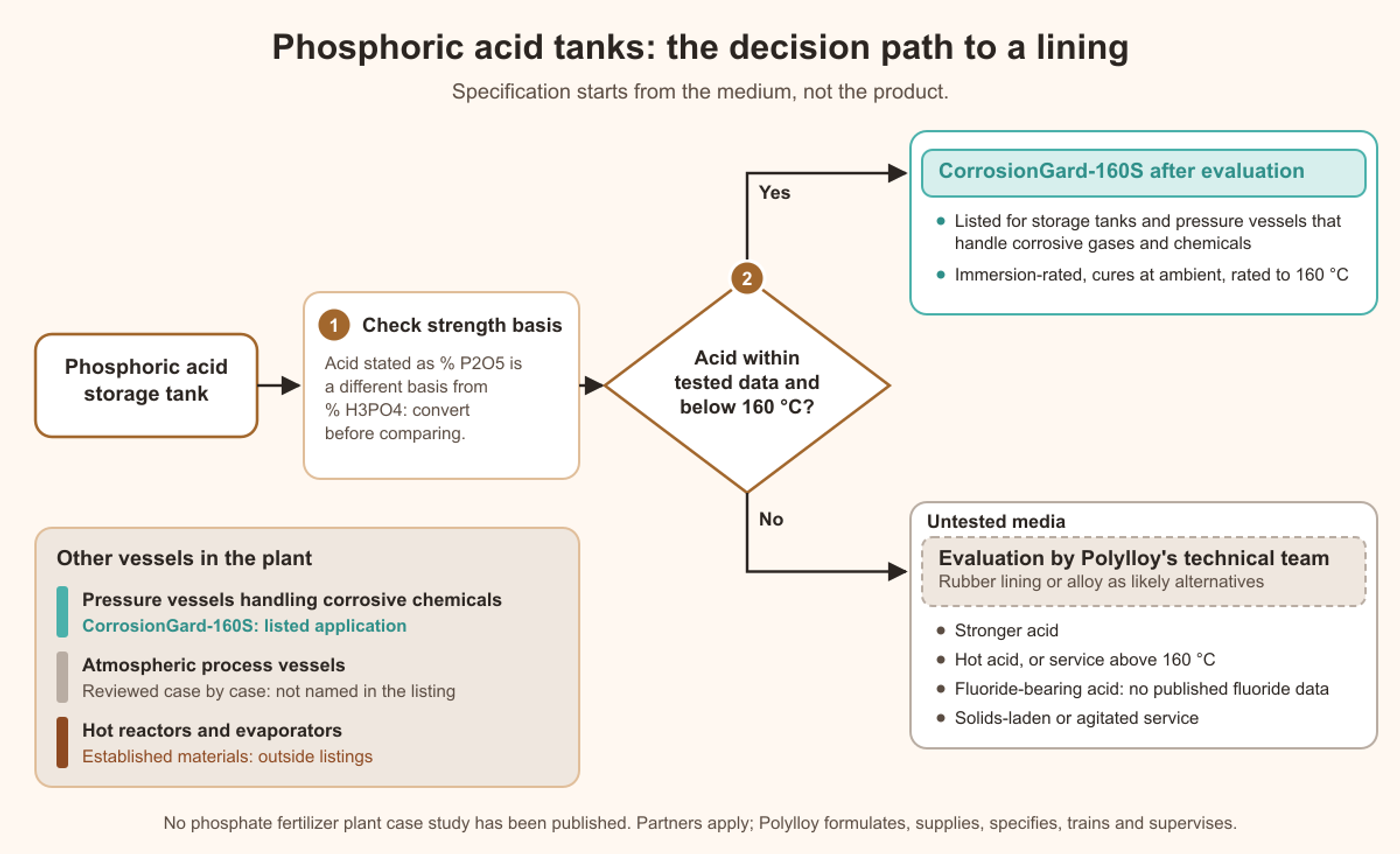
The test is one week, the bulletin does not print the immersion temperature, and it covers 54 % H3PO4 only. Plants often state acid strength as % phosphorus pentoxide (P2O5), which is a different basis from % H3PO4, so convert before comparing.
Stronger acid, hot acid, fluoride-bearing acid and acid with suspended solids are untested media that need evaluation by Polylloy's technical team. The CorrosionGard-160S bulletin addresses osmotic blistering from airborne contamination during preparation, covered further under severe chemical service coating suppliers. Ambient cure suits tanks that never see process heat.
Process and Pressure Vessels in Fertilizer Service
The listing names some vessels and not others.
Where the Listing Applies and Where It Stops
The listing is "storage tanks and pressure vessels that handle corrosive gases and chemicals". Pressure vessels within 160 °C and the published media fit it; atmospheric process vessels are not named and are reviewed case by case by Polylloy's technical team, and every vessel is confirmed for its exact chemistry and exposure.
Hot reactors, digesters, filters and evaporators in acid production are outside the bulletin listings. Rubber linings, alloys, carbon brick or other systems chosen by the process licensor usually stay there. For vessels being designed in 316 stainless, protected carbon steel may offer a cost-effective alternative to stainless steel where the coating is suitable for the specified service conditions.
Fluoride-Bearing Scrubber Off-Gas Ducts
Off-gas ducts to the scrubbers can carry fluoride compounds and acid condensate.
FlueGard-225SQC for Acid Gas Ducts
FlueGard-225SQC is a two-component polymeric alloy rated to 225 °C (437 °F), resistant to sulfur trioxide (SO3), sulfur dioxide (SO2), HCl, carbon dioxide (CO2), HF and nitrogen oxides (NOx). It is immersion-rated, with one-week weight gain below 0.5 % in 54 % H3PO4 and below 1.0 % in 3 % HF (ASTM D471), Taber abrasion below 30 mg and adhesion above 3,000 psi.
No Polylloy bulletin lists fertilizer plants. FlueGard-225SQC is considered for these ducts on its gas resistance and immersion data, and each duct is reviewed case by case by Polylloy's technical team; see FlueGard flue gas coatings.
As a heat-cured grade it fits only where final heat cured activation can be completed during start-up using process heat. Fertilizer off-gas ducts that run cool may not allow this, and the review checks it first.
Wet Scrubber Bodies
Continuously wetted scrubber bodies with fluoride-bearing liquor often stay with established linings, thermoplastics or alloys. Any coating there must be immersion-rated, FlueGard-225SQC or CorrosionGard-160S, and CorrosionGard-160S publishes no fluoride data, so the zone is reviewed first.
Dryer and Granulator Off-Gas Ducts and Baghouses
Dryer and granulator lines mix dust with acid-forming gas.
Acid Gas, Dust and Condensate at Cold Spots
Dryer and granulator off-gas typically carries product dust and can carry fluoride and other acid-forming compounds and moisture. Where duct or baghouse steel runs below the dew point, condensate and damp dust collect at duct floors, flanges, hoppers and doors.
FlueGard-225SQC is the candidate grade, reviewed case by case, since its baghouse and duct listings name cement plants and waste incinerators, not fertilizer plants, and it fits only where start-up process heat can complete its heat cure. Where steel stays dry and near ambient, a conventional coating may be enough; gas-side detail for chemical sites is under chemical plant corrosion protection.
Where Rubber Lining, Alloy or a Conventional Coating is the Better Fit
A coating is one option among several.
Honest Limits
Rubber lining or alloy is often the better fit in these cases:
- Hot or strong phosphoric acid beyond the tested data.
- Fluoride-rich acid or liquor.
- Solids-laden or agitated service.
- Acid production equipment, which usually stays with the licensor's materials.
- Small, complex or inaccessible parts, which may suit an alloy.
- Service above 160 °C, where CorrosionGard-160S does not apply.
Structural steel in fertilizer plants is not a bulletin-listed application for any Polylloy grade. Where exposure is mild and dry, a conventional coating system is adequate; anything else is reviewed per project. Polylloy's own six-month 56% sulfuric acid immersion test of FlueGard-225SQC at 60 °C showed no observed deterioration; it was not independent and was not phosphoric acid.
What is Proven for Fertilizer Service
No phosphate fertilizer plant case study has been published. The data on this page is bulletin data, and performance detail comes from Polylloy's technical team for the project under review.
How to Specify Phosphate Fertilizer Plant Corrosion Protection
Specification starts from the medium, not the product.
Specification Inputs and Decision Path
Inputs per item: acid strength and basis (H3PO4 or P2O5), temperature range, fluoride and sulfate content, solids, exposure type, steam-out cycles and lining history. The decision path runs as follows:
- Acid within tested data and below 160 °C: CorrosionGard-160S after evaluation.
- Untested strength, hot or fluoride-rich acid: evaluation, with rubber lining or alloy as likely alternatives.
- Off-gas ducts and baghouses to 225 °C: reviewed case by case for FlueGard-225SQC where start-up process heat can complete its heat cure.
- Structural steel: not listed; a conventional system where mild.
Preparation is a Society for Protective Coatings (SSPC) SP10 near-white blast with a profile above 3 mils (75 µm), with salt testing before lining. Partners apply; Polylloy formulates, supplies, specifies, trains and supervises. Pricing depends on the operating environment, selected coating system, equipment condition, project size, and application requirements.
To scope your plant, request a coating evaluation with the item, coated area, acid strength and basis, temperature, fluoride, location and outage timing.
FAQs
How Do You Protect Phosphoric Acid Tanks from Corrosion?
Match the lining to the acid's strength, temperature, fluoride and solids content. CorrosionGard-160S is listed for storage tanks handling corrosive chemicals and gained below 0.5 % after one week in 54 % phosphoric acid (ASTM D471). Stronger, hotter or fluoride-bearing acid is an untested medium that needs evaluation, and rubber lining or alloy may fit better.
Is CorrosionGard-160S Suitable for Phosphoric Acid Storage Tanks?
Within its data, yes. The bulletin lists storage tanks and pressure vessels handling corrosive gases and chemicals, rates it to 160 °C and reports below 0.5 % weight gain in 54 % phosphoric acid over one week. The immersion temperature is not printed, so your acid's strength, temperature and impurities are evaluated by Polylloy's technical team first.
Does 54 % Phosphoric Acid in a Coating Data Sheet Mean 54 % P2O5?
No: the bulletin figure is 54 % phosphoric acid (H3PO4) by weight. Fertilizer plants often state acid strength as % P2O5, which is a different basis, and the same acid gives a higher number when expressed as H3PO4. Convert your acid strength to the same basis before comparing it with any immersion data.
What Coating Suits a Storage Tank Handling Corrosive Chemicals in a Fertilizer Plant?
One with published resistance to the actual medium at the actual temperature. CorrosionGard-160S publishes one-week data in 10 % hydrochloric, 54 % phosphoric and 10 % sulfuric acid and water, cures at ambient and is immersion-rated to 160 °C. Media outside that data, including fluoride-bearing liquor, are reviewed before a lining is specified.
Can Fluoride-Bearing Scrubber Ducts in a Phosphate Plant Be Coated?
Gas-side ducts can be reviewed for FlueGard-225SQC, which resists hydrogen fluoride and sulfur oxides to 225 °C and reports below 1.0 % weight gain in 3 % HF. No bulletin lists fertilizer plants, so each duct is reviewed case by case and fits only where start-up process heat can complete its heat cure; wetted scrubber bodies often stay with established linings or alloys.
Has Polylloy Published a Phosphate Fertilizer Plant Case Study?
No: no phosphate fertilizer plant case study has been published, and no Polylloy bulletin lists fertilizer plants or their structural steel. The data on this page is bulletin data, and Polylloy's technical team provides performance detail for the project under review. Certified partners apply the coatings under Polylloy's specification and supervision.

Surjit Gill
Co-founder, Polylloy Coatings
Surjit Gill is co-founder of Polylloy Coatings, which develops innovative hybrid coatings to protect industrial equipment against high-temperature corrosion, chemical attack, and abrasion in severe-service applications worldwide. Trained in chemical engineering and business management, he brings leadership experience spanning startup incubation and business growth. He focuses on commercializing materials innovation, scaling organizations, and advancing go-to-market strategy through global partnerships.
Related Signals
Smelter Corrosion Protection: Off-Gas Ducts, Filters, Stacks and Structures
Surjit GillThu, Nov 12, 2026
Biomass Boiler Corrosion Protection: Alkali Chlorides in Ducts, Baghouses and Stacks
Surjit GillTue, Nov 10, 2026
Hazardous and Medical Waste Incinerator Corrosion Protection: Kiln, Quench and Ducts
Surjit GillMon, Nov 9, 2026