
Rubber Lining vs Coating for Scrubbers, Absorbers and Acid Tanks
 Edita RojasovaLast Updated: Nov 18, 2026
Rubber Lining vs Coating: Key Points
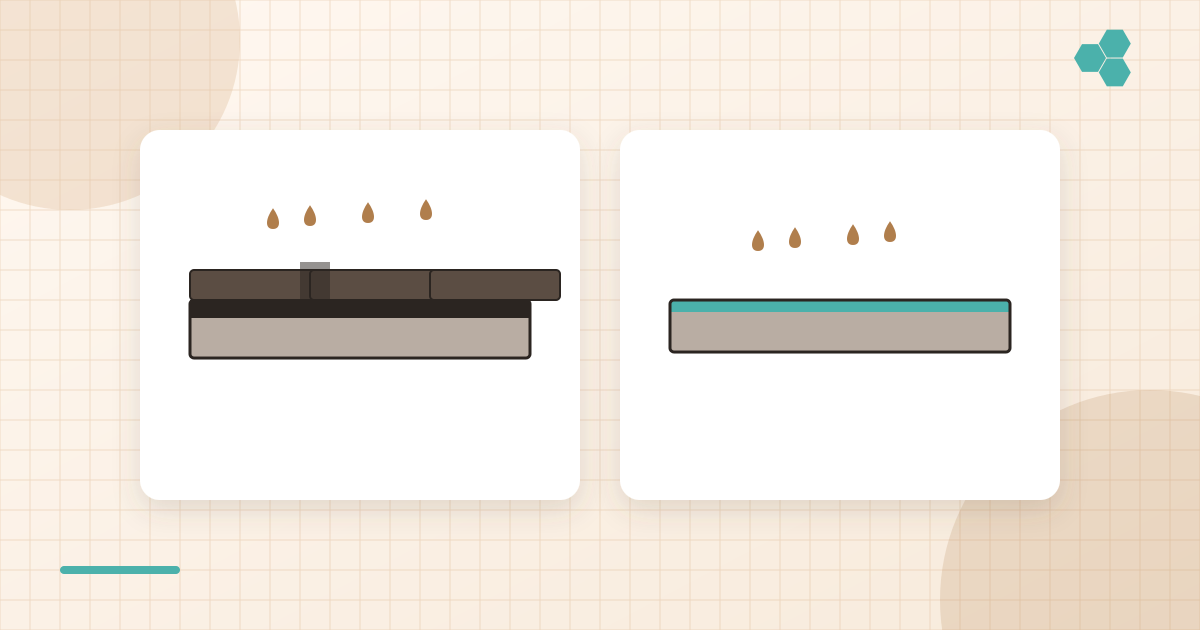
- Rubber lining is a sheet elastomer (natural rubber, bromobutyl or chlorobutyl) bonded to blasted steel and vulcanized; a liquid-applied coating is sprayed or rolled on as a continuous film.
- Rubber linings are established in absorber slurry and acid tank service, where their resilience handles abrasion and impact.
- Of Polylloy's grades, only FlueGard®-225SQC and CorrosionGard®-160S are rated for immersion; the other grades are not candidates for continuously wetted zones.
- FlueGard-225SQC lists flue gas desulfurization (FGD) scrubbers, ducts and chimneys in power plants and refineries to 225 °C (437 °F); CorrosionGard-160S lists storage tanks and pressure vessels to 160 °C (320 °F) and cures at ambient.
- CorrosionGard-160S one-week immersion weight gain is less than 0.5 % in 10% HCl, 54% H3PO4, 10% H2SO4 and water (ASTM D471); untested media still need evaluation.
- Rubber temperature limits, solvent resistance and repair methods vary by compound and come from each lining maker's data sheet for the service.
For an acid tank, choose a rubber lining where abrasive slurry, impact or an owner standard built on rubber dominates and the acid and temperature sit inside the compound's data sheet. Choose an immersion-rated coating such as CorrosionGard-160S to 160 °C, or FlueGard-225SQC to 225 °C, where a seamless film, complex geometry or local repair matter more.
Rubber lining vs coating is the choice between a sheet elastomer lining bonded and vulcanized onto steel and a liquid-applied barrier coating cured on the steel, for the inside of scrubbers, absorbers and tanks that hold or contact acid.
Quick Verdict: Rubber Lining or Liquid-Applied Coating
Verdict: start from the duty, not the price. Rubber lining is the established choice for continuously wetted absorber slurry zones and for acid tanks with abrasion, impact or a rubber-based owner standard.
An immersion-rated liquid coating, CorrosionGard-160S to 160 °C with ambient cure or FlueGard-225SQC to 225 °C, fits where seams, geometry, local repair or ambient-cure scheduling decide it. In every case, suitability is confirmed for the exact acid, strength and temperature.
Rubber Lining vs Liquid-Applied Coating, Compared
The rubber lining vs liquid-applied coating comparison below covers the attributes that decide most relining specifications:
| Attribute | Rubber lining | Polylloy immersion grades |
|---|---|---|
| Form | Bonded sheet | Sprayed or rolled film |
| Chemistry | Natural, bromobutyl or chlorobutyl elastomer | FlueGard-225SQC polymeric alloy; CorrosionGard-160S hybrid |
| Joints | Overlapped seams | Seamless |
| Cure | Vulcanized per lining spec | 225SQC heat cured; 160S ambient |
| Temperature basis | Per compound data sheet | 225 °C; 160 °C |
| Immersion rating | By compound | Yes, both grades |
| Published acid data | Maker resistance tables | ASTM D471 weight gain |
| Slurry abrasion and impact | Resilient elastomer | Taber below 30 mg; below 100 mg |
| Surface preparation | Per lining spec | SSPC-SP10, profile above 3 mils |
| Inspection | Spark test per spec | Holiday test, film thickness |
| Repair | Per lining maker procedure | Local preparation and recoat per Polylloy procedure |
| Track record | Long, broad in absorbers and acid tanks | Project-specific review |
| Cost drivers | Sheet, labor, vulcanizing, outage | Preparation, area, access, outage |
Read the table in order: acid and temperature first, then abrasion, geometry and repair. Rubber cells are deliberately generic, because rubber limits vary by compound and belong to each lining maker's data sheet.
How a Rubber Lining Protects Steel: Sheet, Bond and Vulcanization
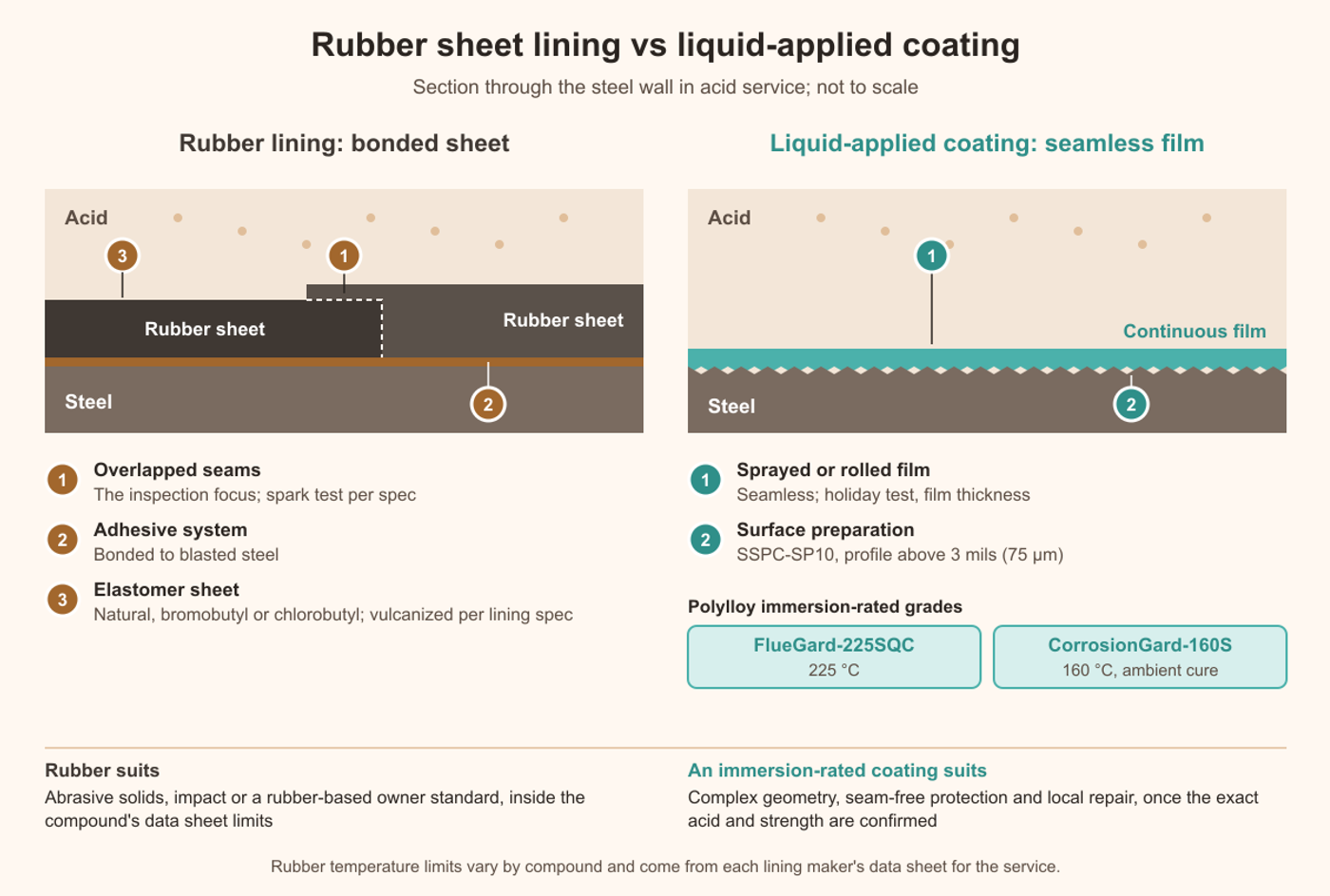
A rubber lining protects steel by placing a thick, bonded elastomer sheet between the acid and the wall.
What a Rubber Lining Is
A rubber lining is a calendered elastomer sheet, commonly natural rubber, bromobutyl or chlorobutyl, bonded with an adhesive system to blasted steel. The sheets are laid with overlapped seams and then vulcanized according to the lining maker's procedure.
The result is a thick, resilient barrier that tolerates slurry abrasion and impact. That resilience is why rubber is established in absorber slurry service.
Where a Rubber Lining is Vulnerable
Seams and overlaps are the inspection focus, because they are where a sheet lining can open. Temperature excursions must be checked against the compound's rating, including upset conditions.
Solvent and oxidizing-acid compatibility depends on the compound, and adhesion at edges and nozzles needs attention. Each of these limits comes from the lining maker's data sheet for the service.
How a Liquid-Applied Coating Protects Steel in Acid Immersion
A liquid-applied coating protects steel in acid immersion as a continuous film bonded to blast-cleaned steel, with no sheet seams.
Only Immersion-Rated Grades Belong in Wetted Zones
Of Polylloy's grades, only FlueGard-225SQC and CorrosionGard-160S are rated for immersion. FlueGard-425S, KilnGard, StackGard and WearGard-625S are not, so they are not candidates for continuously wetted zones.
FlueGard-225SQC
FlueGard-225SQC is a two-component polymeric alloy, 100 % solids, rated to 225 °C (437 °F). It resists sulfur trioxide (SO3), sulfur dioxide (SO2), hydrogen chloride (HCl), carbon dioxide (CO2), hydrogen fluoride (HF) and nitrogen oxides (NOx). Its bulletin lists FGD scrubbers, ducts and chimneys in power plants and refineries.
Its bulletin reports one-week weight gain below 1.0% in 37% hydrochloric acid, below 0.5% in 54% phosphoric acid, below 0.5% in 36% sulfuric acid and below 1.0% in 3% hydrofluoric acid. It is heat cured: final heat cured activation is completed during start-up using process heat.
In Polylloy's own six-month sulfuric acid immersion test, in 56% sulfuric acid at 60 °C, there was no observed deterioration; it is not an independent test. Grade data are on the FlueGard flue gas coatings page.
CorrosionGard-160S
CorrosionGard-160S is a two-component, single-layer, ambient-cure coating rated to 160 °C (320 °F), and its bulletin lists storage tanks and pressure vessels that handle corrosive gases and chemicals. One-week immersion weight gain is less than 0.5 % in 10% HCl, 54% H3PO4, 10% H2SO4 and water (ASTM International D471); untested media still need evaluation.
The bulletin also reports Taber abrasion below 100 mg and adhesion above 2,000 psi (ASTM D4541). Product detail is on the CorrosionGard ambient-cure coating page.
Rubber Lining vs Coating in FGD Scrubbers and Absorbers
In FGD scrubbers and absorbers, the rubber lining vs coating decision splits by zone: slurry zones on one side, gas-side and intermittently wet zones on the other.
Absorber Slurry Zones
Continuously wetted, high-chloride absorber zones are traditionally rubber-lined, flake-lined or alloy-clad, and rubber's resilience suits gypsum slurry abrasion. Rubber is often the right answer here.
FlueGard-225SQC is listed for FGD scrubbers, ducts and chimneys in power plants and refineries and is immersion-rated. Polylloy publishes no slurry-specific performance data, so no claim is made for slurry immersion zones, and any such zone goes to Polylloy's technical review.
Gas-Side and Intermittently Wet Zones
Inlet ducts, outlet transitions and gas-side surfaces with intermittent condensate are where a liquid coating such as FlueGard-225SQC fits its bulletin listing most directly. The full zone-by-zone map is in flue gas desulfurization corrosion protection.
Rubber Lining vs Coating in Acid Storage Tanks and Vessels
In acid storage tanks and vessels, the rubber lining vs coating decision turns on the stored acid and how the tank is operated.
Acid Tank Duty
Settle these questions first: the acid and its strength, normal and maximum temperature, and whether the zone is full immersion, vapor space or splash. Then record agitation and solids, fill-drain cycles, and steam-out or cleaning methods.
CorrosionGard-160S cures at ambient, so no start-up heat is needed, which suits tanks that never see process heat. Within 160 °C and inside its tested media, it is the Polylloy option to evaluate; For hotter or flue-gas-connected vessels within 225 °C, FlueGard-225SQC is reviewed case by case by Polylloy's technical team, since its bulletin lists flue gas equipment rather than vessels.
How epoxy linings fail by permeation, osmotic blistering and the cold-wall effect is covered in chemical tank lining: hybrid vs epoxy. For mild duty, see the signs a conventional coating is enough.
When to Choose a Rubber Lining
Choose a rubber lining when the duty plays to its resilience or sits outside the coating grades' tested range.
Cases Where Rubber is the Right Answer
Rubber is the right answer in these cases, each confirmed against the lining maker's data sheet:
- Abrasive slurry or solids in continuous immersion.
- Impact or flexing duty.
- An owner or licensor standard built on rubber with a good service record.
- Acids or temperatures outside the tested range of the coating grades.
- Acid strengths not covered by Polylloy data, for example concentrated or oxidizing acids, where the rubber maker's resistance table covers that service.
When to Choose a Liquid-Applied Coating
Choose a liquid-applied coating when seams, geometry, cure route or repair access decide the job.
Cases Where a Coating Earns the Evaluation
A coating earns the evaluation in these cases:
- Complex geometry with many nozzles, internals or stiffeners, where sheet seams multiply.
- Vessels or ducts that see hot gas as well as condensate within 225 °C (FlueGard-225SQC).
- Tanks without process heat, where an ambient cure fits the outage (CorrosionGard-160S).
- Plants that want local repair by re-blasting and reapplying.
- New carbon steel vessels weighed against 316 stainless steel.
Protected carbon steel may offer a cost-effective alternative to stainless steel where the coating is suitable for the specified service conditions. For mild, stable, ambient chemistry, a conventional epoxy lining is adequate; the trade-offs between resin families are in novolac, vinyl ester and hybrid coatings.
What Drives Rubber Lining and Coating Cost
Rubber lining and coating cost are driven by different factors, so compare them on the same scope.
Cost Factors Only
Rubber lining cost is driven by sheet material, adhesive, labor, vulcanizing method, inspection and outage time. Coating cost is driven by surface preparation, area and thickness, access and confined-space logistics, labor, inspection, curing route, freight and shutdown timing.
Pricing depends on the operating environment, selected coating system, equipment condition, project size, and application requirements. Lifecycle evaluation considers preparation, application, maintenance, downtime, and replacement alongside the initial material cost.
How to Choose Between a Rubber Lining and a Coating
Choosing between a rubber lining and a coating starts with the duty data, gathered zone by zone.
Data to Gather and Next Step
Gather the acid, strength and mixture; normal, maximum and upset temperatures; exposure type per zone; solids and agitation; geometry and access; the outage window; and the existing lining history and failure locations.
Decide zone by zone: many absorbers end with rubber in slurry zones and a coating on gas-side surfaces. Polylloy grades need an SSPC-SP10 / NACE No. 2 near-white blast (Society for Protective Coatings and NACE International standards) with a profile above 3 mils (75 µm), so an existing rubber lining is removed back to blasted steel first.
Certified partners apply the coatings; Polylloy formulates, supplies, specifies, trains and supervises. To book a Coating Performance Review, request a coating evaluation with equipment type, lined area, acid and concentration, temperatures, exposure type, location and outage timing.
FAQs
Should We Use Rubber Lining or a Coating for an Acid Tank?
Decide by the acid, temperature and duty. Rubber lining suits tanks with abrasive solids, impact or a rubber-based owner standard, inside the compound's data sheet limits. An immersion-rated coating such as CorrosionGard-160S, ambient cure to 160 °C, suits complex geometry, seam-free protection and local repair, once the exact acid and strength are confirmed.
Is Rubber Lining or Coating Used in a Wet FGD Absorber?
Continuously wetted, high-chloride absorber slurry zones are traditionally rubber-lined, flake-lined or alloy-clad, and rubber's resilience suits gypsum slurry abrasion. FlueGard-225SQC is listed for FGD scrubbers and is immersion-rated, but no slurry-specific performance data is published, so it is evaluated for gas-side and intermittently wet zones and any slurry zone goes to Polylloy's technical review.
Which Polylloy Coatings Can Be Used in Acid Immersion?
Two grades are rated for immersion: FlueGard-225SQC, to 225 °C, and CorrosionGard-160S, to 160 °C with ambient cure. FlueGard-425S, KilnGard-600SCW, StackGard-255SQW and WearGard-625S are not immersion grades. Suitability for a given tank or scrubber zone still depends on the acid, its strength and the temperature.
What Temperature Can a Rubber Tank Lining Handle?
It depends on the rubber compound and the chemical, so the figure comes from the lining maker's data sheet for that service, including upset conditions. Compare it with the normal, maximum and excursion temperatures of the tank. For the coating side, FlueGard-225SQC is rated to 225 °C and CorrosionGard-160S to 160 °C.
Can a Rubber-Lined Tank Be Converted to a Coating?
Yes, if the steel is sound and the chemistry suits an immersion-rated grade. Polylloy grades need an SSPC-SP10 near-white blast with a profile above 3 mils, so the old rubber and adhesive are removed back to bare steel, thinned plate is repaired, and the coating is applied by a certified partner under Polylloy supervision.
Is an Ambient Cure Lining a Good Fit for an Acid Tank?
It fits tanks that never see process heat, because CorrosionGard-160S cures at ambient and needs no start-up heat. Its bulletin reports less than 0.5 % weight gain after one week in 10% HCl, 54% H3PO4, 10% H2SO4 and water. Other acids, strengths and temperatures need evaluation by Polylloy's technical team.

Edita Rojasova
Co-founder and Chief Technology Officer, Polylloy Coatings
Edita Rojasova is co-founder and Chief Technology Officer of Polylloy Coatings, Inc., which develops hybrid polymer-alloy-ceramic technologies that protect industrial equipment in extreme environments against high-temperature corrosion, chemical attack, and abrasion. A materials scientist educated at the Slovak University of Technology in Bratislava, she holds a master’s degree in chemical engineering and fuel processing and a PhD in organic technology, with a focus on catalysis and the modification of inorganic substrates. She brings expertise in both organic and inorganic chemistry, integrating the two into true hybrid protective systems. Her specializations include electrochemistry, corrosion mechanisms of metallic substrates, and the chemistry of the substrate–coating interface. An inventor with multiple U.S. patents, she leads Polylloy’s R&D, guiding new formulations from testing and characterization through to field implementation.
Related Signals
Shop-Applied vs Field-Applied Coatings for New Ducts and Stacks
 Surjit GillMon, Oct 26, 2026

Novolac Epoxy vs Vinyl Ester vs Hybrid Coatings for Baghouses
Edita RojasovaSun, Sep 20, 2026