
7 Best Acid-Resistant Coatings for Steel, by Acid: Sulfuric, Hydrochloric, Hydrofluoric, Phosphoric
 Edita RojasovaLast Updated: Nov 18, 2026

Acid-Resistant Coatings for Steel: Key Points
- Seven options cover most acid duty on steel: Polylloy's FlueGard®-225SQC and CorrosionGard®-160S, novolac epoxy, glass-flake vinyl ester, rubber linings, fluoropolymer linings, acid-resistant brick and tile, and phenolic coatings.
- Choose by acid, strength, temperature and phase: acid condensate on a hot gas-side wall is a different duty from continuous liquid immersion.
- FlueGard-225SQC bulletin one-week weight gain: 37% HCl below 1.0%, 54% phosphoric below 0.5%, 36% sulfuric below 0.5%, 3% HF below 1.0%; rated to 225 °C (437 °F) and immersion-rated.
- CorrosionGard-160S one-week immersion weight gain is less than 0.5 % in 10% HCl, 54% H3PO4, 10% H2SO4 and water (ASTM D471); ambient cure, to 160 °C (320 °F).
- For HF-rich cement gas, FlueGard-225SQC has about 24 months on a French cement plant fan housing exposed to HF, HCl, SOx and dust, at below 250 °C continuous with short excursions approaching 280 °C, above its 225 °C rating, so such duty is confirmed project by project.
- Every other option is rated by its maker's resistance table; glass- or silica-filled systems need HF-specific data before use.
To resist sulfuric acid on steel, use a coating with sulfuric acid data at your strength and temperature: FlueGard-225SQC (below 0.5 % weight gain in 36% H2SO4; no observed deterioration in Polylloy's own six-month test in 56% at 60 °C) or CorrosionGard-160S for 10% H2SO4. Novolac epoxy, glass-flake vinyl ester, rubber, fluoropolymer, brick and phenolic options rest on maker tables.
Acid-Resistant Coatings for Steel Defined by Acid and Phase
An acid-resistant coating for steel is a barrier film or lining that keeps a named acid, at a stated strength and temperature, from reaching the steel, either as condensate from gas or as liquid in immersion, with published resistance data for that acid.
Acid, Strength, Temperature and Phase
The seven options on this page are coatings and linings, because buyers shortlist both for the same acid duty: rubber, fluoropolymer and brick or tile are linings.
Four acids set the duty. Sulfuric acid (H2SO4) condenses from sulfur trioxide (SO3) and moisture below the acid dew point, typically 120 to 160 °C in cement plant gas (International Cement Review (ICR), May 2026); hydrochloric acid (HCl) forms from chlorine in fuels and waste.
Hydrofluoric acid (HF) appears in some cement kiln gas with alternative fuels, and phosphoric acid (H3PO4) is mainly a process and storage liquid. How each gas component attacks steel is set out in flue gas composition and the corrosion each component causes.
Phase matters as much as the acid. Condensate on a hot wall that wets and dries is not the same duty as continuous immersion, and an "acid resistant" label without acid, strength, temperature and duration is a claim, not data.
How the 7 Acid-Resistant Options Were Selected
The seven acid-resistant options were selected against five criteria:
- Applied to steel as a barrier against at least one of the four acids.
- Used in condensate or immersion service.
- Acid resistance published per acid, by the maker.
- A defined cure and installation route.
- Honest limits, including where the option is more than the duty needs.
Order follows fit to the stated duty: steel exposed to sulfuric, hydrochloric, hydrofluoric or phosphoric acid with published per-acid data. Polylloy is first because FlueGard-225SQC publishes weight-gain data in all four acids plus a six-month sulfuric immersion test; the rest are chemistry classes, not brands. Zinc-rich primers and silicone heat paints are excluded, because acids consume zinc and silicone is a dry-heat coating.
Acid-Resistant Options by Acid at a Glance
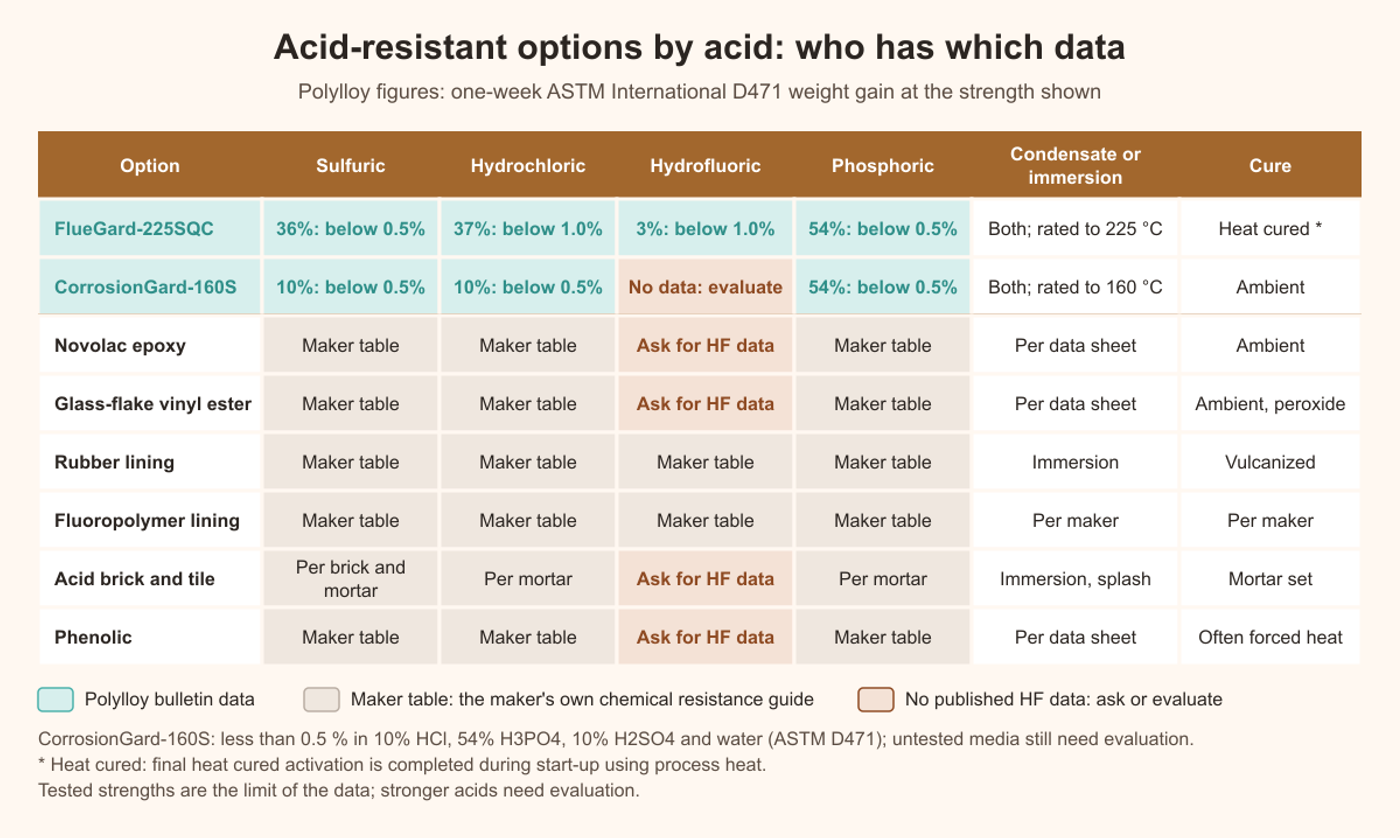
The matrix below shows which option has which data, by acid and phase:
| Option | Sulfuric | Hydrochloric | Hydrofluoric | Phosphoric | Condensate or immersion | Cure |
|---|---|---|---|---|---|---|
| FlueGard-225SQC | 36%: below 0.5% | 37%: below 1.0% | 3%: below 1.0% | 54%: below 0.5% | Both; rated to 225 °C | Heat cured |
| CorrosionGard-160S | 10%: below 0.5% | 10%: below 0.5% | No data: evaluate | 54%: below 0.5% | Both; rated to 160 °C | Ambient |
| Novolac epoxy | Maker table | Maker table | Ask for HF data | Maker table | Per data sheet | Ambient |
| Glass-flake vinyl ester | Maker table | Maker table | Ask for HF data | Maker table | Per data sheet | Ambient, peroxide |
| Rubber lining | Maker table | Maker table | Maker table | Maker table | Immersion | Vulcanized |
| Fluoropolymer lining | Maker table | Maker table | Maker table | Maker table | Per maker | Per maker |
| Acid brick and tile | Per brick and mortar | Per mortar | Ask for HF data | Per mortar | Immersion, splash | Mortar set |
| Phenolic | Maker table | Maker table | Ask for HF data | Maker table | Per data sheet | Often forced heat |
Polylloy figures are one-week ASTM International D471 weight gain at the strength shown. "Maker table" means the maker's own chemical resistance guide is the source.
FlueGard-225SQC and CorrosionGard-160S from Polylloy Coatings
Polylloy Coatings offers two immersion-rated grades for acid duty.
Suited To
FlueGard-225SQC suits acid condensate and immersion on flue gas path steel within its 225 °C rating, including HF-bearing gas. CorrosionGard-160S suits tanks, vessels and structures to 160 °C in its tested acids, where no process heat is available.
What It Is
FlueGard-225SQC is a two-component polymeric alloy, 100 % solids, rated to 225 °C (437 °F), resistant to SO3, sulfur dioxide (SO2), HCl, carbon dioxide (CO2), HF and nitrogen oxides (NOx). Its bulletin lists baghouses, electrostatic precipitators (ESPs) and ducts, flue gas desulfurization (FGD) scrubbers, ducts and chimneys, and smelter and battery-recycling ducts, filters and stacks.
CorrosionGard-160S is a two-component, single-layer, ambient-cure coating rated to 160 °C (320 °F); its bulletin lists storage tanks and pressure vessels handling corrosive gases and chemicals, and steel structures and vessels. Of Polylloy's grades, only these two are immersion-rated. Product pages: FlueGard acid-resistant coatings and CorrosionGard ambient-cure coating.
Key Features
- FlueGard-225SQC one-week weight gain: 37% HCl below 1.0%, 54% H3PO4 below 0.5%, 36% H2SO4 below 0.5%, 3% HF below 1.0%.
- FlueGard-225SQC showed no observed deterioration at 60 °C in Polylloy's own six-month 56% sulfuric acid immersion test; it is not an independent test.
- CorrosionGard-160S: less than 0.5 % in 10% HCl, 54% H3PO4, 10% H2SO4 and water (ASTM D471); untested media still need evaluation. No HF data is published for CorrosionGard-160S.
- HF-rich cement gas: FlueGard-225SQC on a fan housing, inlet ducts and transition zones at a French cement plant, installed April 2024, has about 24 months in service with HF, HCl, sulfur oxides (SOx) and high-velocity dust. It ran below 250 °C continuous with excursions approaching 280 °C, above the 225 °C rating, so such duty is confirmed project by project; the detail is in ID fan housing protection.
Cost Factors
Polylloy pricing is project-specific: surface preparation, coated area and thickness, access, applicator labor, inspection, curing route, freight and outage timing.
Pros and Cons
Pros
- Per-acid published data in four acids for FlueGard-225SQC.
- Ambient cure for CorrosionGard-160S; seamless film on complex steel.
- Polylloy laboratory and field testing comparing FlueGard with conventional high-temperature coatings observed undercutting corrosion and delamination in the conventional coatings.
Cons
- An SSPC-SP10 / NACE No. 2 near-white blast (Society for Protective Coatings and NACE International standards) with a profile above 3 mils (75 µm) is mandatory.
- FlueGard-225SQC is heat cured: final heat cured activation is completed during start-up using process heat.
- Tested strengths are the limit of the data, stronger acids need evaluation, and the grades stop at 160 °C and 225 °C.
- Certified partners apply; Polylloy formulates, supplies, specifies, trains and supervises.
Novolac Epoxy Coatings for Sulfuric Acid Condensate Within the Data Sheet
Novolac epoxy is a familiar resin option for acid condensate.
Suited To
Novolac epoxy suits sulfuric and hydrochloric acid condensate zones, such as outlet sections and hoppers, running inside the product's dry-gas and immersion ratings.
What It Is
Novolac epoxy is an epoxy novolac resin with higher crosslink density than standard epoxy, often glass-filled, with an ambient amine cure. Its chemistry is compared with vinyl ester and hybrids in novolac, vinyl ester and hybrid coatings.
Key Features
- Separate dry-heat and immersion ratings, each from the maker's data sheet.
Cost Factors
Novolac epoxy pricing is project-specific, driven by area, surface preparation, number of coats, access and outage timing.
Pros and Cons
Pros
- Familiar to specifiers and applicators, and ambient cure.
Cons
- Dry-heat and immersion ratings differ, so check both.
- Highly crosslinked films can be brittle under thermal shock, and glass-filled grades need HF-specific data.
Glass-Flake Vinyl Ester Linings for Wet and Oxidizing Acid Service
Glass-flake vinyl ester is a resin lining for wet acid service.
Suited To
Glass-flake vinyl ester suits continuously wet acid zones, FGD scrubbers, stacks and ducts within the resin rating, including oxidizing acids.
What It Is
Vinyl ester is an epoxy backbone with methacrylate end groups and a peroxide cure. Glass flake in the film lengthens the permeation path that liquid must travel to reach the steel.
Key Features
- Multi-coat lining built from flake-filled layers.
Cost Factors
Vinyl ester lining pricing is project-specific, driven by the number of coats, environmental control during application, access and outage timing.
Pros and Cons
Pros
- Broad acid resistance and a long specification history.
Cons
- Application-sensitive to humidity, substrate temperature and styrene handling; multi-coat.
- Glass flake needs HF-specific data from the resin supplier.
Rubber Linings for Acid Immersion and Abrasive Slurry
Rubber linings are a sheet option for acid immersion.
Suited To
Rubber linings suit acid tanks and absorber zones in continuous immersion, especially with slurry or impact.
What It Is
A rubber lining is a sheet elastomer, such as natural rubber, bromobutyl or chlorobutyl, bonded to blasted steel and vulcanized.
Key Features
- A thick, resilient barrier that tolerates slurry abrasion and impact.
Cost Factors
Rubber lining pricing is project-specific, driven by sheet material, adhesive, labor, vulcanizing method, inspection and outage time.
Pros and Cons
Pros
- Resilient barrier with a long record in absorber slurry and acid tanks.
Cons
- Seams and overlaps need inspection.
- Temperature, oxidizing-acid and solvent limits vary by compound, and repair follows the lining maker's procedure.
Fluoropolymer Linings for Severe Mixed-Acid Service
Fluoropolymer linings are a further barrier option for strong chemical service.
Suited To
Fluoropolymer linings suit strong or mixed acid service where resin and rubber ratings fall short.
What It Is
Fluoropolymer linings are fluoropolymer sheet or applied linings on steel. Types, attachment methods and temperature limits are set by each maker.
Key Features
- Available as sheet or applied linings, depending on the maker.
Cost Factors
Fluoropolymer lining pricing is project-specific, driven by specialist fabrication and installation, geometry and outage timing.
Pros and Cons
Pros
- Broad chemical resistance, per maker data.
Cons
- Specialist fabrication and installation, with geometry and attachment limits.
- Any HF, temperature or permeation claim needs the maker's data.
Acid-Resistant Brick and Tile Linings Over a Membrane
Acid-resistant brick and tile is a thick masonry option.
Suited To
Brick and tile linings suit acid containment, sumps, floors and vessels with heat, abrasion or mechanical load, where a thick masonry lining is acceptable.
What It Is
Acid-resistant brick or tile is set in chemical-resistant mortar over an impervious membrane on the steel or concrete. The membrane stops acid that passes the joints.
Key Features
- Two barriers: the masonry face and the membrane behind it.
Cost Factors
Brick and tile pricing is project-specific, driven by masonry and membrane labor, installation time, structural support and outage timing.
Pros and Cons
Pros
- Thick, abrasion-tolerant and long established.
Cons
- Weight and installation time; joints and mortar decide acid resistance.
- Silica-based materials and mortars need HF-specific data. CorrosionGard-160S is not a replacement for acid brick or refractory.
Phenolic and Epoxy-Phenolic Coatings for Strong Acids on Shop-Cured Parts
Phenolic and epoxy-phenolic coatings are thin, dense films.
Suited To
Phenolics suit strong acid exposure on components cured under controlled conditions, often in a shop.
What It Is
A phenolic or epoxy-phenolic coating is a thin, dense, highly crosslinked film with low permeability when properly cured. Its place among other chemistries is covered in anti-corrosion coating types.
Key Features
- Often needs a controlled forced heat cure.
Cost Factors
Phenolic coating pricing is project-specific, driven by part size, shop curing, handling and transport.
Pros and Cons
Pros
- Dense, low-permeability film at low thickness.
Cons
- Forced heat cure is hard on large site-built steel.
- Limited abrasion allowance, and rigid under thermal cycling.
Matching the Option to Sulfuric, Hydrochloric, Hydrofluoric or Phosphoric Acid
Matching the option to the acid starts from what has been tested.
Sulfuric Acid
For condensate on gas-path steel within 225 °C, FlueGard-225SQC has 36% data. For dilute sulfuric liquid in tanks within the 160 °C rating, CorrosionGard-160S has 10% data, and other strengths and temperatures need evaluation; stronger or hotter sulfuric acid is checked against the maker tables for vinyl ester, rubber, fluoropolymer or brick.
Hydrochloric Acid
FlueGard-225SQC has one-week 37% HCl data and CorrosionGard-160S has 10% data; other strengths and temperatures need evaluation.
Hydrofluoric Acid
FlueGard-225SQC lists HF gas resistance and 3% HF data, plus the French fan housing record above its 225 °C rating, confirmed project by project. CorrosionGard-160S has no HF data, so HF duty must be evaluated, and glass-flake, silica-filled and brick systems need HF-specific data.
Phosphoric Acid
Both Polylloy immersion grades report below 0.5% at 54% H3PO4. Other options rely on their maker tables.
How to Choose an Acid-Resistant Coating for Steel
Choosing among acid-resistant coatings and linings comes down to the data behind the label.
Data to Ask Every Supplier For
Ask every supplier for the following:
- Acid and strength tested, temperature and duration.
- Immersed and vapor-phase results.
- Method standard, for example ASTM D471 weight gain or a NACE TM0174 panel test.
- Substrate, surface preparation, film thickness and cure route.
- Who ran and reviewed the test.
If your acid, strength or temperature is outside the published data, ask for project-specific confirmation instead of extrapolating.
Mild Service, Cost and Next Step
Mild, dilute, ambient splash with a good conventional record does not need a severe-service grade. Pricing depends on the operating environment, selected coating system, equipment condition, project size, and application requirements; named products are listed in chemical service coating suppliers.
To book a Coating Performance Review, request a coating evaluation with equipment type, coated area, acid and strength, temperature, condensate or immersion, abrasion, location and outage timing.
FAQs
Which Coating Resists Sulfuric Acid on Steel?
Pick one with sulfuric acid data at your strength and temperature. FlueGard-225SQC reports below 0.5% weight gain after one week in 36% sulfuric acid and showed no observed deterioration in Polylloy's own six-month test in 56% at 60 °C. CorrosionGard-160S reports less than 0.5 % in 10% sulfuric acid. Vinyl ester, novolac and linings rely on maker tables.
What Chemicals is CorrosionGard-160S Resistant To?
Its bulletin reports one-week immersion weight gain less than 0.5 % in 10% hydrochloric acid, 54% phosphoric acid, 10% sulfuric acid and water, tested to ASTM D471. It is ambient cure, rated to 160 °C and immersion-rated. Other chemicals, strengths and temperatures are untested in the bulletin and need evaluation by Polylloy's technical team.
What Coating Protects Steel from Hydrofluoric Acid in Cement Kiln Gas?
Look for a coating that lists HF and has field service in HF-bearing gas. FlueGard-225SQC lists HF gas resistance, reports below 1.0% weight gain in 3% HF, and has about 24 months on a French cement fan housing in HF, HCl and SOx; that duty ran above its 225 °C rating, so it is confirmed project by project. Glass- or silica-filled systems need HF-specific data.
Is a Coating or a Lining Better for Hydrochloric Acid Tanks?
It depends on strength, temperature and solids. CorrosionGard-160S has one-week 10% hydrochloric acid data and is rated to 160 °C with ambient cure; FlueGard-225SQC has 37% data and a 225 °C rating. Other strengths and temperatures need evaluation. Rubber, fluoropolymer and brick linings are evaluated for stronger acid, slurry or heavy load against their makers' resistance tables and limits.
What Acid Immersion Test Data Should I Ask a Coating Supplier For?
Ask for the acid and strength, temperature, duration, immersed and vapor phase results, the method standard such as ASTM D471 or a NACE TM0174 panel test, film thickness, surface preparation, cure route and who ran the test. A label that says acid resistant without these details is not enough to specify from.
Does Acid Condensate Need a Different Coating from Acid Immersion?
Often yes. Condensate on gas-path steel wets and dries with temperature swings and shutdowns, while immersion is continuous liquid contact. FlueGard-225SQC, rated to 225 °C, and CorrosionGard-160S, rated to 160 °C, are immersion-rated, with immersion at temperature confirmed per duty. Other Polylloy grades are not immersion-rated, and resin linings carry separate dry and immersion ratings.

Edita Rojasova
Co-founder and Chief Technology Officer, Polylloy Coatings
Edita Rojasova is co-founder and Chief Technology Officer of Polylloy Coatings, Inc., which develops hybrid polymer-alloy-ceramic technologies that protect industrial equipment in extreme environments against high-temperature corrosion, chemical attack, and abrasion. A materials scientist educated at the Slovak University of Technology in Bratislava, she holds a master’s degree in chemical engineering and fuel processing and a PhD in organic technology, with a focus on catalysis and the modification of inorganic substrates. She brings expertise in both organic and inorganic chemistry, integrating the two into true hybrid protective systems. Her specializations include electrochemistry, corrosion mechanisms of metallic substrates, and the chemistry of the substrate–coating interface. An inventor with multiple U.S. patents, she leads Polylloy’s R&D, guiding new formulations from testing and characterization through to field implementation.
Related Signals
Clinker Cooler Exhaust Ducts and Vent Filters: 6 Abrasion Protection Options
 Surjit GillWed, Nov 4, 2026
7 Design Rules to Prevent Acid Condensation in Flue Gas Ductwork
Edita RojasovaSun, Oct 25, 2026
Flue Gas Composition: 7 Components and the Corrosion Each Causes
Edita RojasovaSat, Oct 24, 2026